- +971 43807099
- +971 563244963
- brisunco@emirates.net.ae

- Meet Us
Shed No. 10,
Fresh Express Warehouse, Road B1, DIP 1,
Dubai, UAE.
Shed No. 10,
Fresh Express Warehouse, Road B1, DIP 1,
Dubai, UAE.
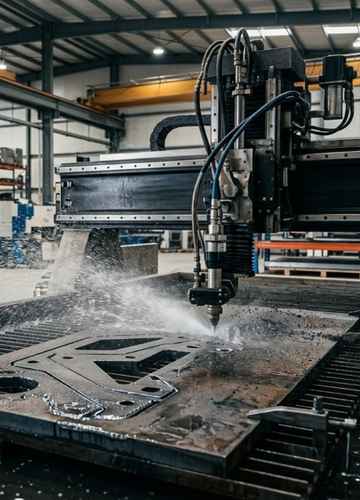
New
New
Put a thin steel sheet and a thick aluminium plate on the same cutting list, and the better process may change straight away. That is the practical side of waterjet cutting vs laser cutting industrial work. No machine is right for every job. Material, thickness, heat, quantity and finish all matter. For UAE factories and engineering teams, the right choice can mean less rework and smoother production.
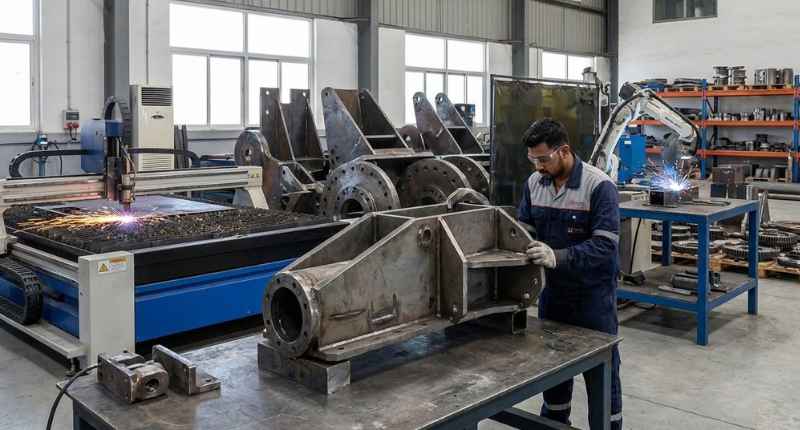
At Brightsun, cutting is part of a wider machining and fabrication process. This guide shows where each method works well and what to check before production starts.
At a Glance
Both methods can follow a programmed path and create complex shapes. What happens at the cutting edge, however, is very different. Waterjet uses water and abrasive force. Laser uses concentrated heat.
How Waterjet Cutting Works
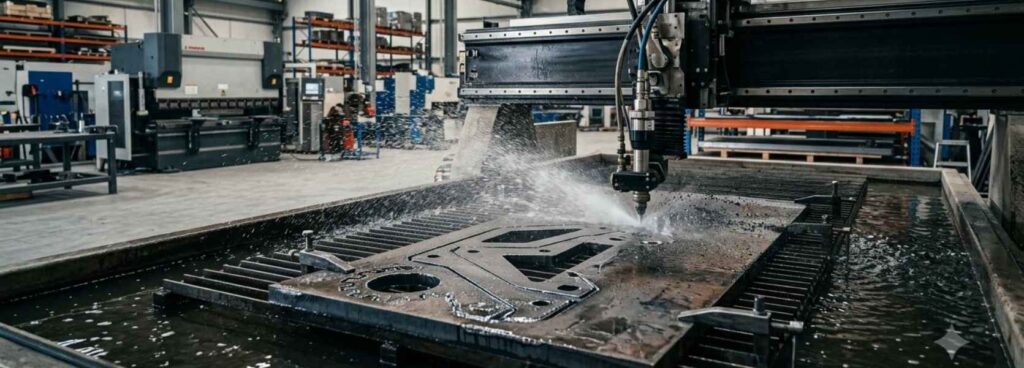
A waterjet forces water through a tiny opening at very high pressure. When hard material such as metal needs to be cut, abrasive particles are mixed into the water stream.
The useful part is what the process does not add: cutting heat. That can matter when the area close to the cut needs to stay as close as possible to its original condition.
Research on abrasive waterjet cutting describes it as a cold machining technique with little thermal effect on the workpiece.
How Laser Cutting Works
Laser cutting takes a different route. A focused beam puts intense heat onto a small area. Assist gas then helps clear the molten material from the cut.
On thin sheet, this can be very fast. It also works well when a part has small details or tight shapes. Machine settings still matter. Research into laser cutting of stainless steel shows that cutting speed and focus can affect kerf width, surface roughness and final cut quality.
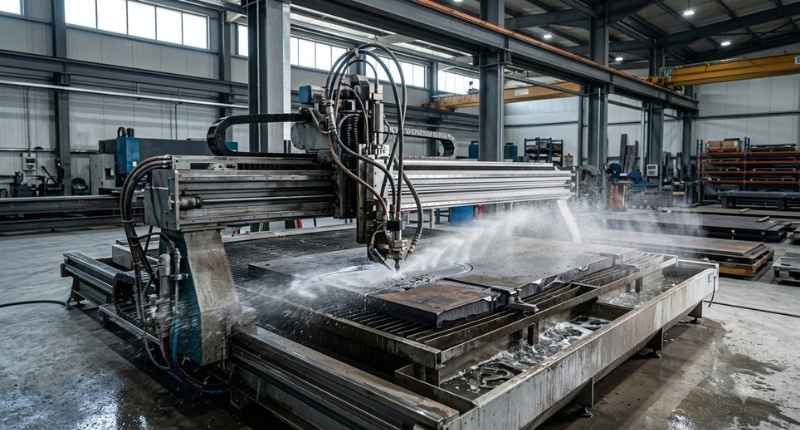
It is beneficial to have a glimpse of the key differences before deciding how to cut metal UAE projects most effectively.
Factor | Waterjet Cutting | Laser Cutting |
Cutting process | High-pressure water + abrasive | Focused laser beam |
Heat affected zone | No | Yes |
Thick materials | Excellent | More limited |
Thin sheet speed | Moderate | Very fast |
Material range | Very wide | More selective |
Detailed thin-metal work | Good | Excellent |
Edge finish | Clean, no heat damage | Clean, but heat effects are possible |
Heat-sensitive parts | Excellent choice | May not be suitable |
Typical strength | Versatility | Speed and fine detail |
There is no automatic winner in waterjet cutting vs laser cutting industrial work. The material, thickness and next production step usually point to the better option.
Material flexibility is one of waterjet’s strongest advantages.
Waterjet can process stainless steel, mild steel, aluminium, copper, alloys, plastics, composites and several non-metal materials. It is especially useful where heat around the cut is a concern.
Laser cutting is widely used for steel, stainless steel and aluminium. Modern systems can handle many metal fabrication jobs quickly, but the laser process still introduces heat.
For buyers looking for the best cutting method for metal UAE projects involving mixed or heat-sensitive materials, waterjet can therefore offer greater flexibility.
Brightsun also integrates cutting with more extensive metal fabrication and machining services, which might make it easier to require cutting, bending, machining, and welding.
Thickness often makes the choice clearer. Laser performs very well on thin and medium sheet, but its practical speed changes as material gets thicker. ISO 9013:2017 covers geometrical specifications and quality tolerances for thermal cutting, including laser-cut material within its stated range. Waterjet is worth considering when thicker material must be cut without a thermal process.
Brightsun’s own waterjet cutting service has a 3 m × 2 m bed and can handle materials up to 150 mm thick, including metals, plastics, wood and fibres.
Heat matters too. Waterjet uses a high-speed abrasive stream rather than a hot beam. Research into laser-cut aluminium shows that process settings can influence the heat-affected zone and kerf quality. This matters when the condition near the cut edge is important.
For a closer look at waterjet capabilities on thick sections, including thickness ranges, taper and cut quality, see waterjet cutting for thick metal plates.
For hundreds of similar sheet-metal panels, speed can have a real effect on cost, and laser will often have the advantage. It moves quickly through thin material and handles detailed profiles well. Waterjet is generally slower, but machine speed is only part of the cost. Less correction or finishing later can also save time.
Waterjet Cutting vs Laser Cutting Industrial for Precision Work
For waterjet cutting vs laser cutting industrial precision work, both methods have a place. Laser is often the better fit for very fine details in thin sheet. Waterjet becomes attractive when good accuracy is needed across thicker or more varied materials.
For a project that later needs CNC work, it can also help to understand the step-by-step CNC machining process and how cutting fits into the full production plan.
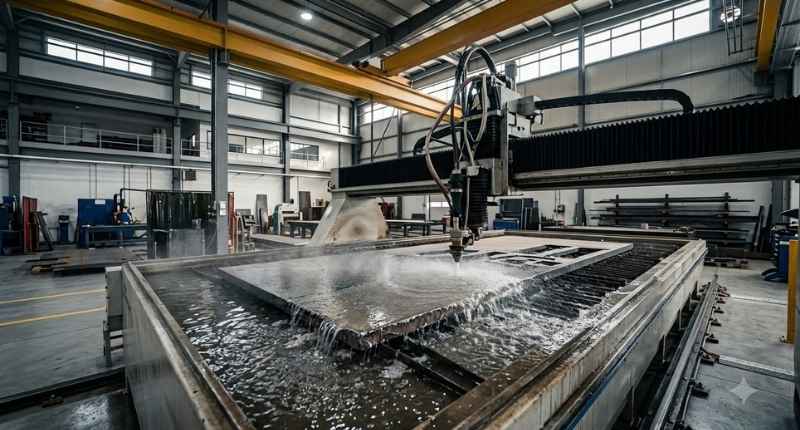
There is no one-price answer. Laser can make financial sense for large batches of thin sheet because it cuts quickly. Waterjet may offer better value on thick or heat-sensitive parts, especially when it helps avoid extra work after cutting.
For projects requiring only a few custom components, production volume becomes another important cost consideration; see how cost-effective waterjet cutting for small batch orders can help businesses plan low-volume work.
The best cutting method for metal UAE buyers should therefore be based on total production cost, not only the cutting rate.
For a wider view of local pricing factors, see Brightsun’s 2026 metal fabrication cost guide.
Start with the drawing and material specification rather than asking which machine is “best”.
The wider UAE market makes this choice more important. Under the national Operation 300Bn industrial strategy, the country aims to raise industry’s contribution to GDP from AED 133 billion to AED 300 billion by 2031. This puts more focus on efficient local manufacturing and production quality.
Current Abu Dhabi manufacturing data highlights around 888 factories with AED 369.32 billion in investment value.
One of the key pillars of Operation 300Bn is UAE Industry 4.0. It strives to improve the digital transformation of the industrial sector, nurture major industrialists during their journey, enhance the productivity of the sector and generate thousands of new and high-skill employment.
Choose laser cutting when:
These process-selection considerations are especially relevant when evaluating waterjet cutting applications in industries across oil and gas, construction, and other UAE fabrication projects.
Choose waterjet cutting when:
For many mixed industrial projects, the best cutting method for metal UAE operations may even involve more than one process.
Official UAE manufacturing insights also point to wider use of digital manufacturing, robotics, 3D printing and automated systems. Cutting choices can therefore affect repeat jobs, material use and turnaround time.
In the waterjet cutting vs laser cutting industrial debate, waterjet becomes especially useful beyond standard thin-sheet work. It can handle thick plates and unusual materials without adding cutting heat.
Brightsun’s workshop works with metal fabrication, CNC and conventional machining, bending, welding and waterjet cutting. Buyers can explore how these processes work together in the company’s guide to custom metal fabrication services in Dubai.
For a closer look at how waterjet cutting avoids thermal effects and preserves the material at the cut edge, read No Heat-Affected Zone: Why Waterjet Cutting Preserves Material Integrity.
Many industrial parts still need machining, bending or welding after cutting. Brightsun brings these services together, helping clients move from a drawing towards a finished component with fewer supplier hand-offs.
For UAE businesses comparing the best cutting method for metal UAE projects, this wider capability can be valuable when the job involves more than a simple cut.
So, which one should you choose? In waterjet cutting vs laser cutting industrial work, thin sheet, fine detail and fast repeat cutting often point towards laser. Thick plate, mixed materials or concern about heat often point towards waterjet.
Need the Right Cut? Contact Brightsun today for reliable waterjet cutting, machining and fabrication support for your industrial project.
Waterjet uses high-pressure water, often mixed with abrasive material. Laser cutting uses a focused beam that heats the material. Waterjet is a cold process, while laser is a thermal process.
Often, yes. Waterjet can handle much thicker material than many laser systems. Brightsun’s waterjet equipment, for example, can cut material up to 150 mm thick.
For many thin sheet-metal jobs, yes. Laser cutting is usually faster, making it useful for high-volume production.
Waterjet. It does not create a heat-affected zone, which helps protect heat-sensitive materials.
The best metal-cutting method in the UAE is determined by material, thickness, tolerance, quantity, and finish. A laser is usually used with thin, high-volume sheet work, whereas waterjet is utilised with thick or heat-sensitive material.
Yes. Waterjet can cut stainless steel, aluminium, mild steel, and most alloys. It is also capable of processing plastic and other types of materials.
Yes. Modern waterjet machines are capable of creating correct profiles and intricate shapes. Additional machining may be necessary in the case of additional final tolerances.
It depends on the job. Laser might be cheaper in high-speed thin-sheet production, whereas waterjet can be valuable on thick or heat- sensitive components.
In the waterjet cutting vs laser cutting industrial job, factors to consider before choosing would be the type of material, thickness, heat sensitivity, tolerance, quantity, edge quality and overall cost of production.
Yes. Brightsun provides waterjet cutting as part of its wider machining and fabrication services in Dubai. Its listed waterjet capacity includes a 3 m × 2 m bed and cutting thickness up to 150 mm.
At a Glance
Related Blogs

Shed No. 10, Fresh Express Warehouse,
Road B1, Dubai Investments Park 1,
Dubai, UAE.
+971 43807099
+971 563244963
+971 503226480