- +971 43807099
- +971 563244963
- brisunco@emirates.net.ae

- Meet Us
Shed No. 10,
Fresh Express Warehouse, Road B1, DIP 1,
Dubai, UAE.
Shed No. 10,
Fresh Express Warehouse, Road B1, DIP 1,
Dubai, UAE.
New
New
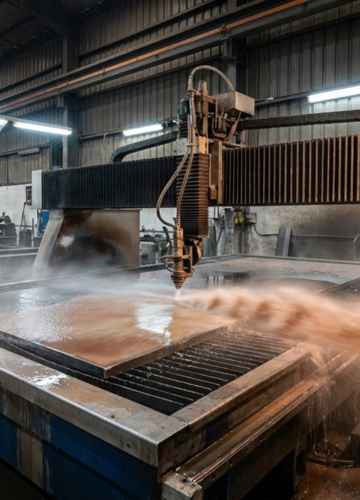
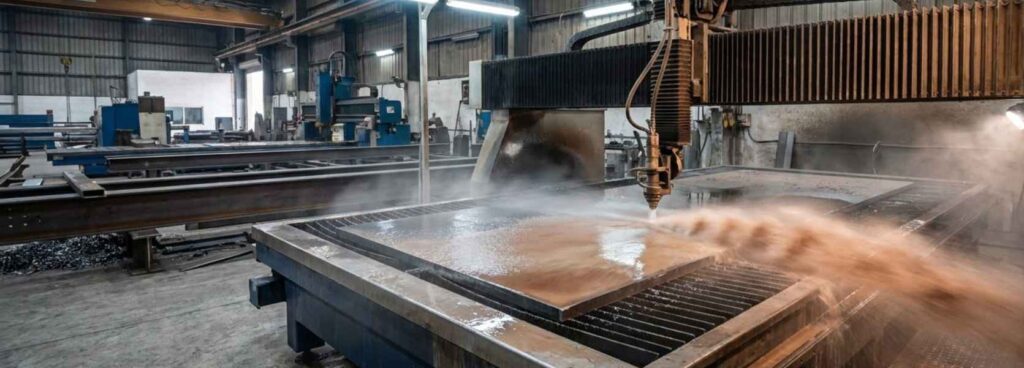
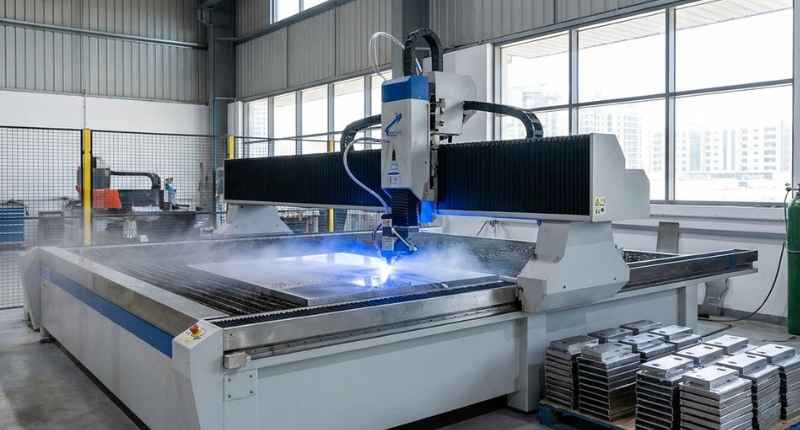
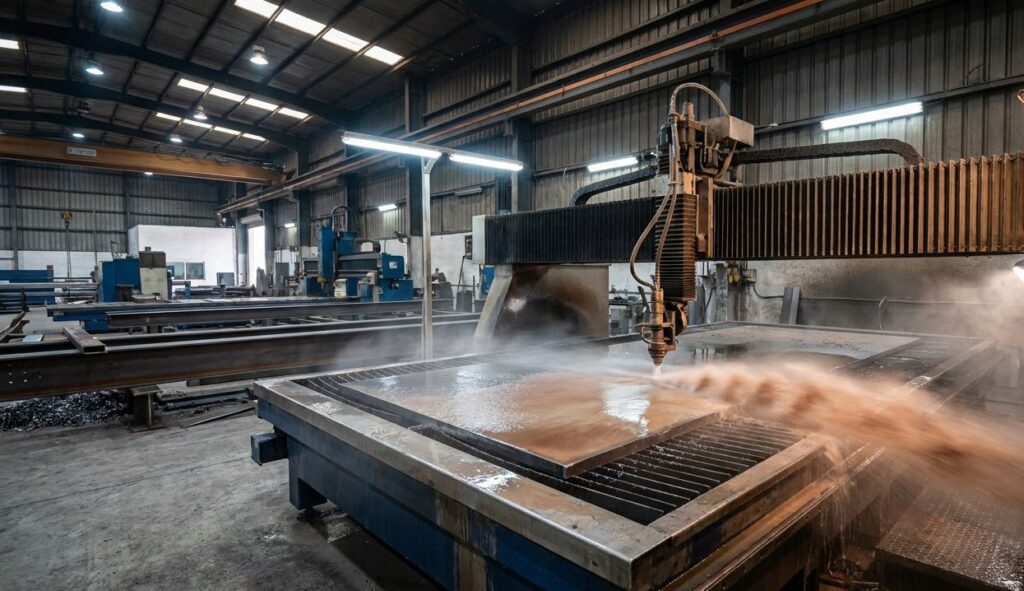
Most cutting processes have a comfortable range and a limit. Laser cutting handles thin to medium sheet well and loses accuracy and speed as thickness increases. Plasma cutting performs strongly on medium-thickness carbon steel and produces progressively worse edge quality and heat-affected zones on thicker sections. When plate thickness pushes beyond what these processes handle cleanly, waterjet cutting thick metal plates becomes the relevant option for fabricators and industrial buyers across the UAE.
But waterjet cutting has its own capabilities and its own limits. Understanding both before specifying the process saves time, money, and the frustration of discovering mid-project that the cutting method cannot deliver what the drawing requires.
For applications where protecting the material properties at the cut edge is critical, waterjet cutting with no heat-affected zone offers a major advantage over thermal cutting methods.
At a Glance
The mechanics of waterjet cutting do not change with plate thickness. High-pressure water mixed with abrasive garnet is forced through a small nozzle at pressures between 3,800 and 6,200 bar. The abrasive jet erodes material along the programmed path.
What changes with thickness is the relationship between cutting speed, jet pressure, abrasive flow rate, and the quality of the cut that emerges at the bottom of the plate. On thin material, the jet passes through quickly, and the cut quality is consistent from top to bottom. On thick material, the jet loses energy as it travels deeper into the plate. The bottom of the cut lags behind the top, producing a curved kerf bottom and increasing taper on the cut edge. Managing these effects is what separates capable waterjet cutting operations from ones that produce inconsistent results on demanding sections.
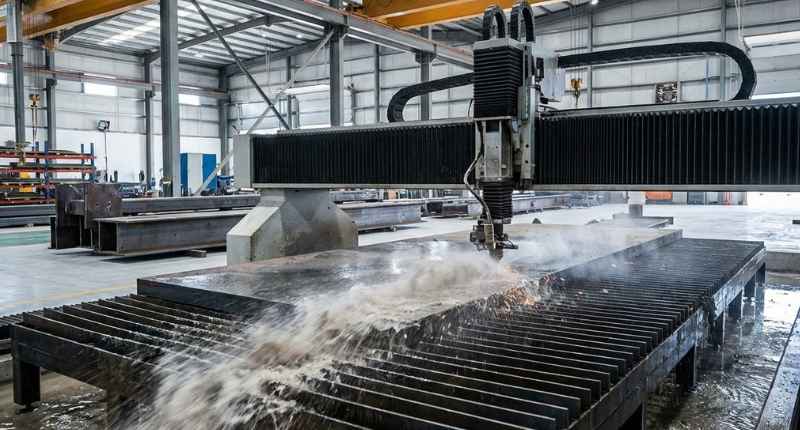
The question UAE buyers ask most often is: what is the maximum thickness waterjet cutting can handle?
The honest answer is that maximum thickness depends on the material, the required cut quality, and the acceptable cutting speed. Steel plate up to 200mm thick can be waterjet cut on well-maintained high-pressure systems. Beyond 100mm, cutting speed drops significantly and cut quality requires careful management. Plate in the 150mm to 200mm range is achievable but slow, and the cut quality at those thicknesses requires realistic expectations about edge taper and surface finish.
For practical production work across UAE fabrication projects, the comfortable working range for waterjet cutting thick metal plates in steel is 6mm to 100mm. In this range, the process delivers consistent dimensional accuracy, manageable taper, and acceptable surface finish without the speed penalty becoming prohibitive.
When only a limited number of thick components are required, buyers can also consider cost-effective waterjet cutting for small batch orders to manage material use, cutting time, and production quantity.
Stainless steel cuts at slightly lower speeds than carbon steel at equivalent thicknesses due to its higher toughness and work-hardening behaviour. Aluminium cuts faster than steel at equivalent thicknesses because it is softer and erodes more readily. Titanium, duplex stainless, and high-alloy materials cut more slowly than standard carbon or austenitic stainless steel and require higher abrasive flow rates to maintain cut quality.
These are the realistic working ranges for maximum thickness waterjet cutting UAE fabrication projects encounter across common materials:
Mild steel and structural steel cut cleanly to 100mm at practical production speeds. Sections from 100mm to 150mm are achievable with reduced speed and increased abrasive consumption. Beyond 150mm, cut quality becomes difficult to maintain consistently, and alternative processes or pre-machining to reduce thickness before waterjet cutting should be considered.
Stainless steel in grades 304 and 316 cuts well to 80mm at practical speeds. Duplex and super duplex grades cut to similar thicknesses but at lower speeds due to higher strength and toughness. These grades are common in UAE oil and gas fabrication, and waterjet cutting is frequently the preferred process precisely because it avoids the sensitisation that thermal cutting causes in stainless at the cut edge.
Aluminium alloys can be cut to 150mm and beyond at practical speeds due to their lower density and easier erosion characteristics. For structural aluminium used in offshore topsides and transport applications, waterjet cutting is both the technically correct process for preserving heat-treated temper properties and a practical production process at the thicknesses commonly encountered.
Hardened wear plate and tool steel cut to 80mm to 100mm depending on hardness grade. These materials are commonly encountered in UAE mining, construction equipment, and processing plant applications where wear resistance is specified and cut edge hardness must be preserved.
Cut quality in waterjet cutting is described in terms of a quality scale from Q1 to Q5, where Q1 is the fastest, roughest cut and Q5 is the slowest, finest cut. Understanding where your application sits on this scale is important because specifying a higher quality than the application requires adds cost and time without adding value.
Q1 and Q2 cuts are separation cuts. The material is cut through, but the edge quality is not controlled. These are used for rough blanking where the part will be further machined or where edge quality is irrelevant to the application.
Q3 is a standard production cut. The edge is usable as-cut for most structural and general fabrication applications. Surface finish is in the range of Ra 3.2 to Ra 6.3 depending on material and thickness.
Q4 and Q5 are precision cuts. Cutting speed is reduced to improve surface finish and dimensional accuracy. These cuts are specified for functional surfaces, sealing faces, and precision structural connections where the cut edge is used directly without secondary machining. Surface finish achieves Ra 1.6 to Ra 3.2 on Q4 and better than Ra 1.6 on Q5 in favourable conditions.
On thick plate above 75mm, achieving Q4 and Q5 quality becomes progressively more difficult as jet lag and bottom-of-cut taper increase. At these thicknesses, Q3 quality is the realistic expectation for production work, with secondary machining specified where a finer finish or tighter dimensional control is required on functional surfaces.
Kerf width in waterjet cutting is determined by the nozzle orifice size and the abrasive mixing tube diameter. Standard production setups produce a kerf width of 0.8mm to 1.2mm. This is wider than laser cutting on thin material but narrower than plasma cutting on thick sections.
Taper on the cut edge increases with plate thickness. On a 10 mm plate, taper is typically less than 0.5 degrees and is negligible for most applications. On a 100 mm plate, taper of 1.5 to 3 degrees is typical without taper compensation. On systems equipped with a tilting cutting head, taper compensation brings the cut edge back to vertical by angling the head to counteract the natural jet taper. For thick plate applications where edge squareness matters, confirming whether the waterjet system used has taper compensation capability is an important part of the process specification.
Jet lag at the bottom of the cut is the other geometric effect that increases with thickness. The bottom of the cut lags behind the programmed toolpath position because the jet loses directional precision as it travels deeper into the material. On straight cuts, this produces a curved bottom to the kerf that exits the material slightly behind the entry point. On complex profiles with tight corners and curves, jet lag creates rounding at internal corners and overshoot at external corners that must be compensated in the cutting program.
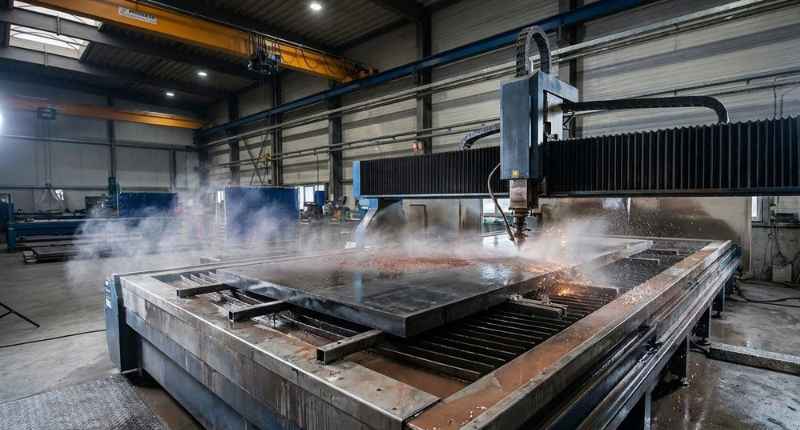
Thick plate waterjet cutting consumes significantly more abrasive garnet than thin sheet cutting. Standard abrasive flow rates for thin to medium plate run from 300 to 500 grams per minute. On thick plate above 75mm, abrasive flow rates of 600 to 900 grams per minute are common to maintain cutting energy at the bottom of the cut.
Abrasive cost is a real component of waterjet cutting pricing in the UAE, and it scales directly with plate thickness and cutting time. A metre of cut on a 100 mm steel plate consumes substantially more abrasive and takes substantially longer than a metre of cut on a 25 mm plate. Buyers comparing waterjet cutting prices across different thicknesses need to understand that the cost per metre of cut is not constant across the thickness range.
Waterjet cutting thick metal plates is the right process when material integrity at the cut edge matters, when the material is unsuitable for thermal cutting, or when dimensional accuracy requirements exceed what plasma cutting can deliver on the section thickness involved.
These requirements also appear across wider waterjet cutting applications in industries, particularly in oil and gas and construction projects where material thickness and cut quality matter.
It is not the right process when speed is the primary requirement, and the material and application can accept the heat-affected zone from plasma cutting. For high-volume carbon steel cutting in thicknesses up to 50mm where edge quality is not a functional requirement, plasma cutting is faster and cheaper and the correct process selection.
It is also not the right process when plate thickness pushes significantly beyond 150mm in steel, because cutting speed at those thicknesses becomes very slow and alternative approaches including pre-machining to reduce thickness, or splitting the cut into two passes from opposite faces, should be evaluated.
For a broader comparison of cutting processes, including thickness, speed, heat effects and material suitability, see waterjet cutting vs laser cutting for industrial use
Waterjet cutting thick metal plates is a capable and precise process within its working range. For steel plates up to 100mm, stainless steel to 80mm, and aluminium to 150mm and beyond, it delivers dimensional accuracy, no heat-affected zone, and cut quality that thermal processes cannot match on demanding materials and applications.
The limits are real. Speed decreases with thickness. Taper increases. Abrasive consumption rises. Cut quality at very thick sections requires realistic expectations and secondary operations where functional surfaces demand it. Understanding these limits before specifying the process is what allows UAE fabrication buyers to get the right outcome from waterjet cutting rather than discovering its boundaries mid-project.
These capabilities make waterjet a practical choice for projects that require the broader benefits of waterjet cutting for industrial projects, from material flexibility to precise, heat-free cutting.
Brightsun Industries provides waterjet cutting services in Dubai and across the UAE for clients working with thick plate, hardened materials, stainless steel, and composites that require precision cutting without heat input.
Contact us to discuss your plate thickness, material specification, and cut quality requirements.
Q1: What is the maximum thickness waterjet cutting UAE operations can handle in steel plate? Steel plate up to 200mm can be waterjet cut on high-pressure systems, with the practical production range for consistent quality and acceptable speed being 6mm to 100mm, beyond which speed drops significantly and cut quality requires careful management.
Q2: How does cut quality change when waterjet cutting thick metal plates above 75mm? Above 75mm, jet lag and edge taper increase progressively, making Q4 and Q5 precision cuts difficult to achieve consistently, with Q3 quality being the realistic expectation for production work and secondary machining required where finer finishes are needed on functional surfaces.
Q3: Why does waterjet cutting speed decrease significantly on thick plate? The abrasive jet loses energy as it travels deeper into the material, requiring slower traverse speeds to maintain erosion rate at the bottom of the cut, which is why cutting time and cost per metre of cut increase substantially with plate thickness.
Q4: What materials are best suited to waterjet cutting in thick sections in the UAE? Aluminium alloys cut well to 150mm and beyond, mild and structural steel cut consistently to 100mm, stainless steel grades 304 and 316 cut to 80mm, and hardened wear plate and tool steel cut to 80mm to 100mm depending on hardness grade.
Q5: What is kerf width and taper in waterjet cutting, and why do they matter on thick plate? Kerf width is the material removed by the cutting jet, typically 0.8mm to 1.2mm, and taper is the angle of the cut edge from vertical, which increases from less than 0.5 degrees on thin plate to 1.5 to 3 degrees on a 100 mm plate without taper compensation.
Q6: Can taper be eliminated on thick plate waterjet cuts? Taper compensation using a tilting cutting head brings the cut edge back to vertical by angling the head to counteract the natural jet taper, and confirming whether the waterjet system has this capability is important when edge squareness is a functional requirement.
Q7: How does abrasive consumption change when cutting thick metal plates by waterjet? Abrasive flow rates increase from 300 to 500 grams per minute on standard thin to medium plate to 600 to 900 grams per minute on thick plate above 75mm, making abrasive cost a significant component of the total cutting cost on thick sections.
Q8: When is plasma cutting a better choice than waterjet cutting for thick plate in the UAE? Plasma cutting is faster and cheaper for high-volume carbon steel cutting up to 50mm where edge quality is not a functional requirement, and the heat-affected zone from thermal cutting is acceptable for the application.
Q9: What is jet lag in waterjet cutting and how does it affect thick plate cut quality? Jet lag is the delay between the programmed toolpath at the top of the cut and the actual cut position at the bottom of the plate, which increases with thickness and produces curved kerf bottoms and rounded internal corners that must be compensated in the cutting program.
Q10: What are the cut quality grades in waterjet cutting and which applies to thick plate production work? Waterjet cut quality ranges from Q1 separation cuts to Q5 precision cuts, with Q3 being the realistic standard for production work on thick plate above 75mm, and Q4 to Q5 reserved for thinner sections or slower cutting speeds where surface finish is a functional requirement.
At a Glance
Related Blogs

Shed No. 10, Fresh Express Warehouse,
Road B1, Dubai Investments Park 1,
Dubai, UAE.
+971 43807099
+971 563244963
+971 503226480