- +971 43807099
- +971 563244963
- brisunco@emirates.net.ae

- Meet Us
Shed No. 10,
Fresh Express Warehouse, Road B1, DIP 1,
Dubai, UAE.
Shed No. 10,
Fresh Express Warehouse, Road B1, DIP 1,
Dubai, UAE.
New
New
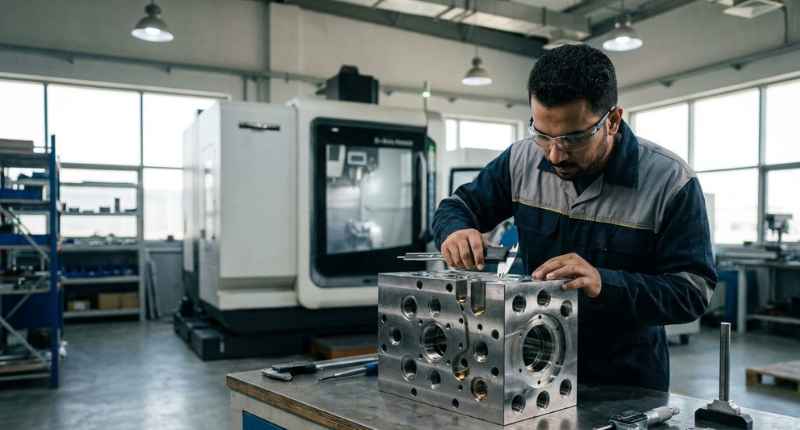
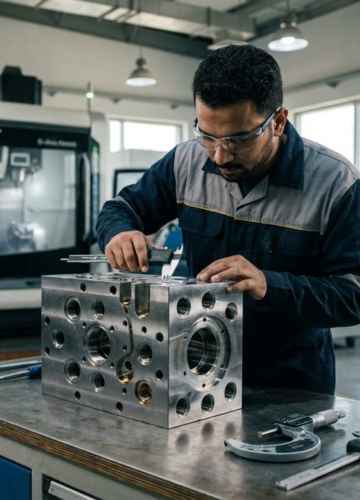
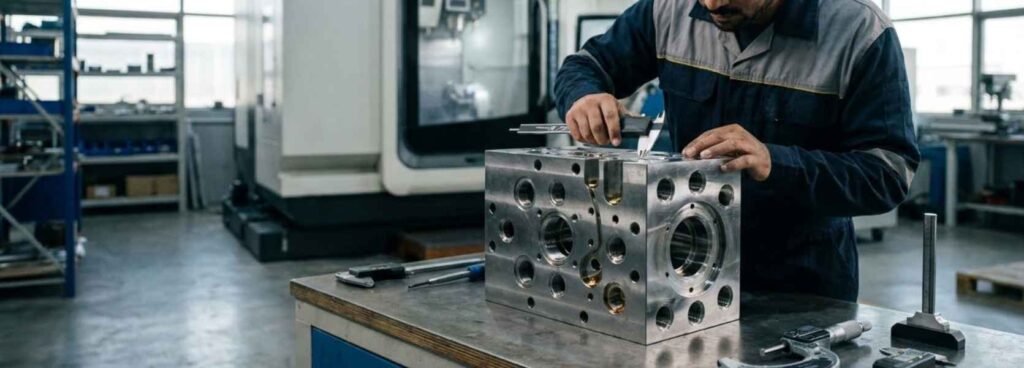
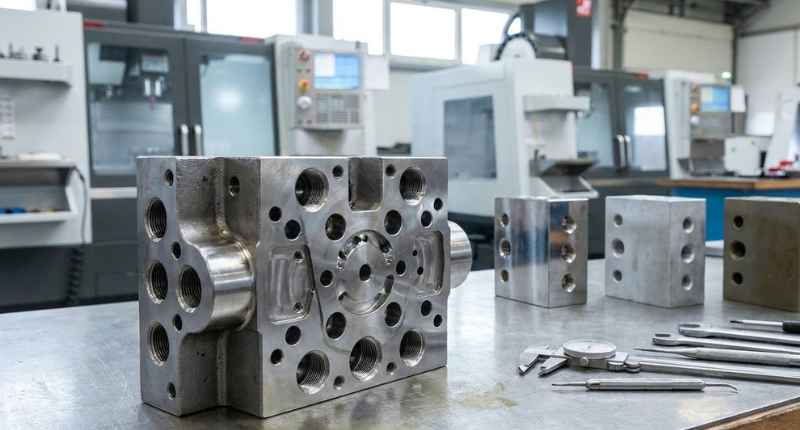
A hydraulic manifold looks just like an ordinary block of solid metal, with holes and ports, at first sight. Look inside, however, and the picture is different. Those holes define well-planned routes that let pressurized fluid pass between pumps, valves, actuators, and return lines.
Even a small machining mistake counts. A hole that is not drilled in the right location, a scarred sealing face, or even a burr hidden in the middle of the block can affect performance.
This is why drilling metal is not the only activity in the hydraulic manifold manufacturing process. At Brightsun, emphasis is on practical design, correct machining, inspection, and testing in line with industrial needs throughout the UAE.
At a Glance
A good manifold begins on the drawing board, not at the CNC machine. Engineers must have a clear idea of the flow of hydraulic fluid through the block before any metal is cut.
The final design is determined by working pressure, flow rate, type of valve, size of port, mounting space, and connection points. The immediate surroundings also matter. With a custom hydraulic manifold UAE project, material and finish are likely to be affected by factors such as heat, dust, moisture, and corrosion.
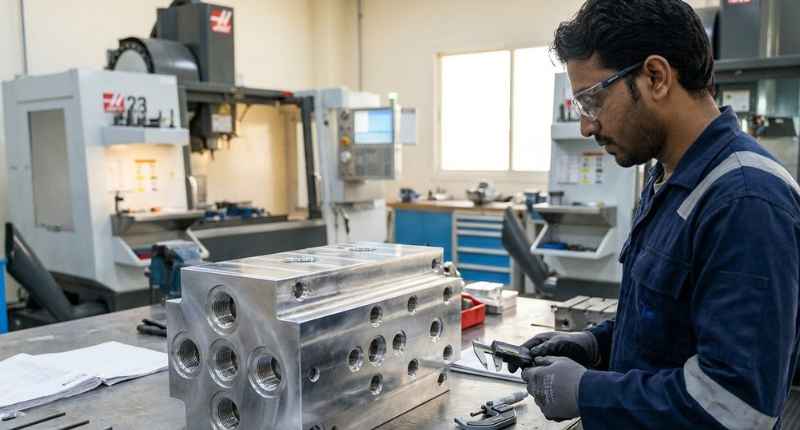
There must be a clear plan for every passage. It should not accidentally enter or connect to another passage. Meanwhile, the design should provide enough space for the machining tools to access every required area.
Important design checks include:
In some cases involving directional valves, mounting surfaces can meet ISO 4401:2005. The standard outlines mounting-surface dimensions and associated details for four-port hydraulic directional control valves.
Designing with machining in mind can help avoid problems later. On a CAD drawing, a passage might seem simple, but when it comes to drilling, inspecting, deburring, or even sealing it during production, it might be problematic.
Once the design is approved, production may start. The exact sequence can vary depending on the block size, material, port count, valve layout, and complexity of internal passages.
Stage | Main Work | Why It Matters |
Design | Plan ports and flow paths | Helps avoid conflicts |
Material preparation | Prepare a metal blank | Creates the machining base |
CNC machining | Machine faces and features | Establishes the required geometry |
Drilling | Create internal passages | Creates the fluid pathways |
Threading | Machine ports and plug holes | Allows secure connections |
Deburring | Remove burrs and sharp edges | Helps keep passages clear |
Inspection | Check sizes and features | Detects production errors |
Testing | Check pressure and leakage | Verifies specified performance |
This is where the drawing becomes a physical component. Faces, mounting areas, pockets, and other exterior features are produced with CNC milling. Fluid passages, ports, valve cavities, and threaded connections are then formed by drilling, boring, and tapping.
Deep passages require special attention. When two holes are drilled within a block, their intersection can leave a burr that is not visible from the outside. The more substantial and intricate the passage network is, the more important machining access and inspection become.
Planning an intricate custom hydraulic manifold UAE project, therefore, should not just be based on how each feature will be cut, but also on how it will later be cleaned and inspected.
Brightsun provides traditional machining and CNC machining, as well as fabrication and other metalwork services in Dubai.
Explore Brightsun Products & Services for more information.
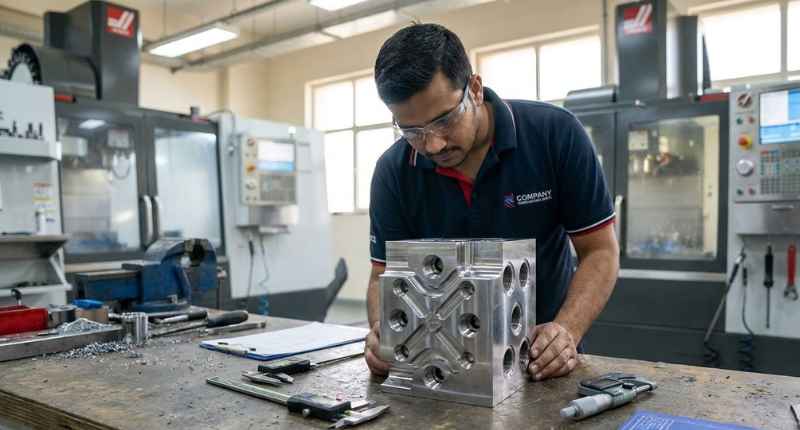
Machining does not end as soon as the last hole is drilled. Intersecting internal passages can leave metal chips and small burrs after drilling.
These unwanted fragments should be eliminated. Deburring removes rough or sharp material around machined areas, whereas cleaning removes loose chips, machining residue, and other debris.
The interior should be given equal consideration to the exterior. Blind holes, cross-passages, ports, and valve cavities must also be checked. What appears to be a clean manifold on the surface could still contain debris in a hidden passage.
The choice of material is not merely a question of selecting the best metal. Factors to consider include pressure, weight, corrosion exposure, machining needs, operating conditions, and the approved specification.
Material | Main Advantage | Key Consideration |
Aluminium | Lightweight and machinable | Should suit its intended purpose |
Carbon steel | Strong and widely used | May need corrosion protection |
Stainless steel | Strong corrosion resistance | Can be more expensive to machine |
Choosing the right material is essential for balancing strength, corrosion resistance, weight, and machining requirements. Read our detailed guide to materials used in manifold manufacturing to compare steel, stainless steel, aluminum, and alloy steel for different industrial applications.
In the case of a custom hydraulic manifold UAE project, the environment must be given careful consideration. A manifold used indoors under controlled conditions can have vastly different requirements from one used on a ship, out in the field, or on a machine that requires durability and reliability.
Price matters, of course. Making a selection based on cost alone can, however, give the illusion of saving money when the material selected does not suit the actual operating environment.
A manifold may appear right on the outside, but there may be a hidden problem inside. That is why inspection should not be limited to the overall length, width, and height.
Depending on the drawing and customer requirements, checks could include:
Before production begins, testing must be agreed upon as well. This may include a dimensional check, visual inspection, pressure test, leak test, or a combination of these, depending on the project.
For manifolds used in demanding industrial applications, understanding the applicable inspection and testing requirements is essential. Read our guide to quality testing standards for industrial manifolds in UAE to learn about pressure testing, material certification, and inspection documentation.
Brightsun says that its customised industrial manifolds may include inlet, outlet, and instrumentation ports according to customer specifications and can be pressure tested.
Machine capability is significant, but it is only part of the picture. The right manufacturer must understand drawings, internal passages, threads, sealing, machining access, cleaning, and inspection as interrelated components of the same project.
For manifold projects involving fabricated pipes, welded branches, flanges, and multiple connections, the industrial manifold manufacturing process provides a broader overview of material preparation, assembly, inspection, and pressure testing.
Before asking for a quotation, prepare:
You may also want to know how deep passages and cross-hole burrs will be handled. For repeat production, ask how the first piece produced will be inspected before the complete batch proceeds.
Since 2006, Brightsun has offered machining and fabrication services in the UAE and operates an ISO 9001:2015-certified engineering workshop. Learn more about Brightsun’s CNC machining capabilities.
The hydraulic manifold manufacturing process starts with a design that can be put into practice and ends with machining, cleaning, inspecting, and testing. Every step is important because the complete manifold should work properly on the inside and not just look good on the outside.
Need a Custom Hydraulic Manifold? Share your drawings with the team to discuss the best manufacturing approach for your requirements. Contact Brightsun to discuss your custom manifold requirements.
The hydraulic manifold manufacturing process turns a hydraulic design into a complete manifold. The processes involved usually include material preparation, CNC machining, drilling, threading, deburring, cleaning, inspection, and testing.
CNC machining can create holes, ports, threads, pockets, valve positions, and mounting features accurately. This can be useful when more than one feature needs to be included in a single compact block.
Common materials include aluminum, carbon steel, and stainless steel. The choice of material depends on the pressure, weight, vulnerability to corrosion, compatibility with fluids, and the operating environment.
Small pieces of metal can be left behind when holes and passages are drilled. With the removal of these burrs, internal passages can remain clear, and the chances of loose machining debris entering the hydraulic system can be reduced.
The process is based on the project specification. Checks can include dimensions, passages, holes, seals, pressure, and leakage. The degree of testing needed and the limits of acceptance should be agreed upon prior to production.
Yes. A prototype can be made before full production. It allows the manufacturer and the customer to inspect the port positions, mounting positions, and access to valves and fittings before a larger batch is approved.
A custom hydraulic manifold UAE solution is appropriate when a standard manifold does not match the required size, port density, material, valve configuration, or hydraulic circuit requirements. In this case, a custom block may be built around the actual equipment.
Yes. The hydraulic manifold manufacturing process directly affects the alignment of passages, cleanliness, sealing, valve fitting, and pressure integrity. Errors concealed within the block may cause problems even though the surface may appear correct.
Start with the drawing or hydraulic schematic. Add working pressure, flow, material, valves, port data, size, quantity, finish, testing data, and inspection data. Clear information helps avoid delays and incorrect production.
Check the approved drawing, materials, ports and threads, valve positions, pressure, finish, inspection procedure, and delivery requirements. For complicated manifolds, also inquire about how internal passages will be deburred, cleaned, and inspected.
Before testing, the manifold needs inspection.
The purpose is simple: confirm that the manufactured part matches the approved requirement.
Checks can cover:
Brightsun’s machining workflow uses tools such as calipers, micrometers, bore gauges, thread gauges, height gauges, and coordinate measuring equipment where appropriate.
A structured quality system also helps make inspection repeatable. ISO describes ISO 9001 as a globally recognized quality management standard focused on controlled processes, customer requirements, performance evaluation, and continual improvement.
Brightsun states that it operates as an ISO 9001-certified engineering workshop. Learn more in its ISO 9001 metal fabrication guide.
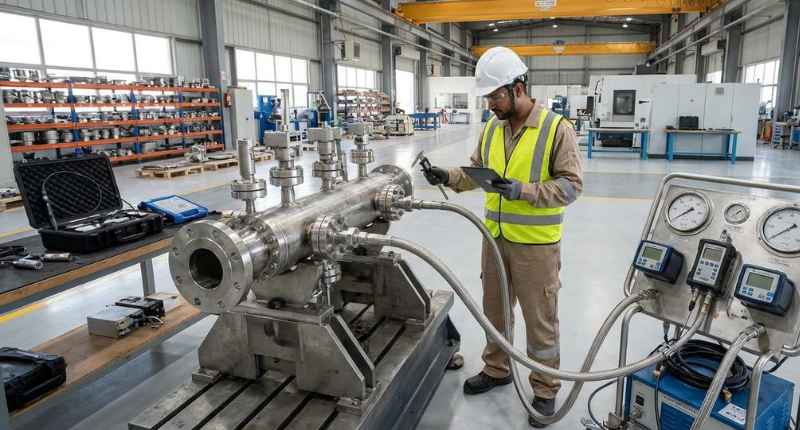
This is one of the most important stages of the industrial manifold manufacturing process.
A manifold may have the right dimensions and still fail to seal correctly. Testing helps verify integrity before the unit enters service.
The exact test method and pressure should follow the approved project specification and applicable standard. It should not be selected from a generic rule.
For example, ASME B31.3 includes specific requirements for examination, inspection, and testing of applicable process piping. Requirements vary with the system, material, service, and test method.
Brightsun states that its custom manifolds can be pressure tested based on customer requirements.
For custom manifold fabrication UAE, buyers should agree on the test pressure, medium, hold requirements, acceptance criteria, and required records before fabrication begins.
For a closer look at the standards and documentation required to verify manifold quality, explore our guide to quality testing standards for industrial manifolds in UAE, covering hydrostatic testing, material traceability, and non-destructive testing.
The final industrial manifold manufacturing process stage is release for delivery.
Ports should be protected against dirt and damage. Identification and documentation should also match the project requirement.
Depending on the order, documents may include material records, dimensional reports, inspection documents, test records, or other customer-requested certificates.
This final check is especially useful for industrial projects where traceability matters.
A custom manifold should solve a specific system problem. That is why sending only a rough sketch can create delays.
For faster custom manifold fabrication UAE, prepare a clear RFQ containing:
Not sure what information a fabricator needs? Brightsun’s guide on getting an accurate fabrication quote explains how better project information can improve quoting.
A reliable industrial manifold manufacturing process also means knowing what can go wrong.
Common risks include incorrect port positions, wrong thread types, unsuitable material, trapped machining burrs, poor weld preparation, contamination, and unclear testing requirements.
One simple way to reduce these risks is to freeze the approved drawing and technical requirements before production.
Last-minute changes may require new machining, replacement material, or rework.
For UAE buyers, choosing a supplier with machining and fabrication capabilities under one roof can also reduce handoffs between different workshops.
Brightsun explains the wider benefits of purpose-built work in its guide to custom fabrication in Dubai.
Price matters, but it should not be the only factor.
When comparing custom manifold fabrication UAE providers, ask whether the workshop can understand drawings, work with the required materials, machine the specified connections, carry out suitable welding, inspect critical dimensions, and perform the required tests.
Also ask:
These questions reveal much more than a price per piece.
Brightsun has been active in the UAE since 2006 and operates an engineering workshop in Dubai Investments Park.
Its capabilities cover CNC and conventional machining, metal fabrication, welding, waterjet cutting, pipe bending, custom fittings, and other made-to-order industrial parts.
For manifolds, Brightsun can produce customized inlet, outlet, and instrumentation arrangements in stainless steel and carbon steel, with leak-resistant welding and pressure testing based on project requirements.
This combined capability makes custom manifold fabrication UAE easier when a project needs both machining and fabrication work.
A reliable manifold is the result of many small decisions made correctly. Material selection, port layout, machining, welding, cleaning, inspection, and testing all play a role in the industrial manifold manufacturing process.
Looking for reliable custom manifold fabrication UAE services? Contact Brightsun today to discuss your drawings, specifications, and project needs.
The industrial manifold manufacturing process covers requirement review, design, material selection, cutting, machining, welding or assembly, deburring, cleaning, inspection, testing, and final release. The exact steps change according to the manifold design and its application.
There is no fixed production time. The schedule depends on design complexity, material availability, machining work, welding, inspection, testing, quantity, and required documentation. A complete drawing usually helps a manufacturer plan the job more accurately.
Stainless steel and carbon steel are common choices for fabricated industrial manifolds. The correct material depends on the fluid, pressure, temperature, corrosion exposure, applicable standard, and customer specification.
For custom manifold fabrication UAE, provide a drawing, material grade, pressure and temperature requirements, service fluid, port locations, connection sizes, thread types, quantity, testing needs, and delivery target.
Pressure or leak testing helps verify the integrity of the completed assembly under the agreed test conditions. The test method and pressure should be based on the project’s design requirements and applicable codes rather than a universal value.
Yes. Inlet and outlet locations, instrumentation ports, connection types, materials, dimensions, and mounting arrangements can be made to suit the application. Brightsun provides custom industrial manifold fabrication based on customer requirements.
Drilling and machining can leave burrs around holes and passage intersections. If loose material remains inside a fluid system, it can cause contamination or interfere with components. Careful deburring and cleaning reduce this risk.
For custom manifold fabrication UAE, check the supplier’s machining, fabrication, welding, inspection, material, and testing capabilities. Also review its quality controls and ability to work from technical drawings.
No. Some manifolds are machined from solid blocks, while others are fabricated from pipes, fittings, plates, flanges, and machined parts. The best method depends on the design, pressure, size, flow arrangement, quantity, and application.
There is no single stage that can guarantee quality. A reliable result comes from controlling the full industrial manifold manufacturing process, from the first design review through material control, machining, welding, cleaning, inspection, and final testing.
At a Glance
Related Blogs

Shed No. 10, Fresh Express Warehouse,
Road B1, Dubai Investments Park 1,
Dubai, UAE.
+971 43807099
+971 563244963
+971 503226480