- +971 43807099
- +971 563244963
- brisunco@emirates.net.ae

- Meet Us
Shed No. 10,
Fresh Express Warehouse, Road B1, DIP 1,
Dubai, UAE.
Shed No. 10,
Fresh Express Warehouse, Road B1, DIP 1,
Dubai, UAE.
New
New
A manifold may look like a simple group of pipes, ports, and fittings. In reality, one small error can affect the flow, sealing, or performance of the whole system. That is why the industrial manifold manufacturing process needs careful planning from the first drawing to the final pressure test.
At Brightsun, custom industrial manifolds are made around the needs of each application. The right material, port layout, welding method, machining accuracy, and testing all matter.
This guide takes you inside the complete process. You will see how manifolds are designed, fabricated, checked, and prepared for industrial use in the UAE.
At a Glance
The industrial manifold manufacturing process is the set of steps used to turn an engineering requirement into a finished manifold that controls or distributes fluid or gas.
A manifold can combine several inlet, outlet, valve, and instrumentation connections in one unit. This can simplify a system and reduce the amount of separate piping and fittings required.
Depending on its use, a manifold may include:
This is why custom manifold fabrication UAE projects normally begin with the application rather than a standard product size.
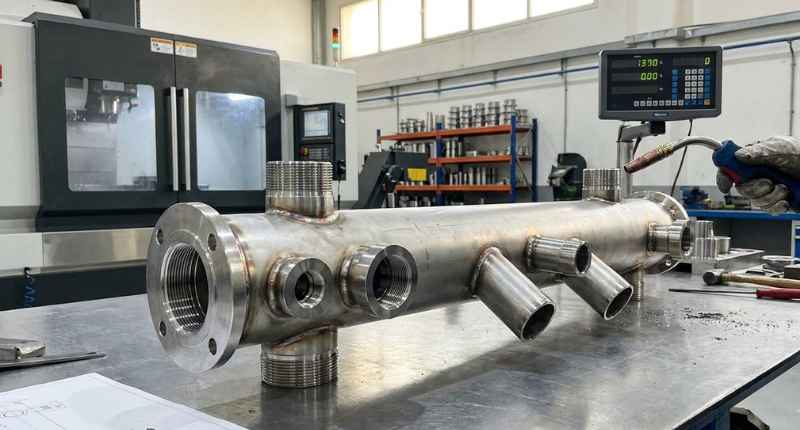
The industrial manifold manufacturing process is not one manufacturing action. It is a controlled sequence.
Here is a simple overview:
Stage | Main Work | Why It Matters |
1 | Requirement review | Defines pressure, flow and connections |
2 | Design and drawings | Sets dimensions and port positions |
3 | Material selection | Supports strength and corrosion needs |
4 | Cutting and preparation | Creates accurate starting parts |
5 | Machining | Produces ports, holes and threads |
6 | Welding and assembly | Joins the manifold parts |
7 | Finishing and cleaning | Removes burrs and contamination |
8 | Inspection | Checks dimensions and workmanship |
9 | Pressure/leak testing | Checks system integrity |
10 | Final documentation | Prepares the manifold for delivery |
Each stage affects the next. Good manufacturing therefore starts long before metal is cut.
The first stage of the industrial manifold manufacturing process is understanding what the manifold must actually do.
Engineers or fabricators need clear information about the service conditions. This may include:
For a custom manifold fabrication UAE project, local operating conditions can also matter. Outdoor equipment, marine environments, industrial plants, and oil and gas applications may have very different corrosion and material needs.
The more complete the specification is, the easier it becomes to avoid changes later.
Once the requirements are clear, the manifold layout can be prepared or reviewed.
This stage defines where the ports, pipes, fittings, valves, flanges, and supports will sit. Engineers also need enough space for welding, machining, tools, assembly, and future maintenance.
The drawing should clearly show dimensions, material grades, connection types, thread details, and any required tolerances.
Brightsun follows a similar drawing-to-production approach in its step-by-step CNC machining process, where drawings, tolerances, materials, threads, and finishing needs are reviewed before machining starts.
A good design is not simply one that works on a screen. It must also be practical to manufacture and inspect.
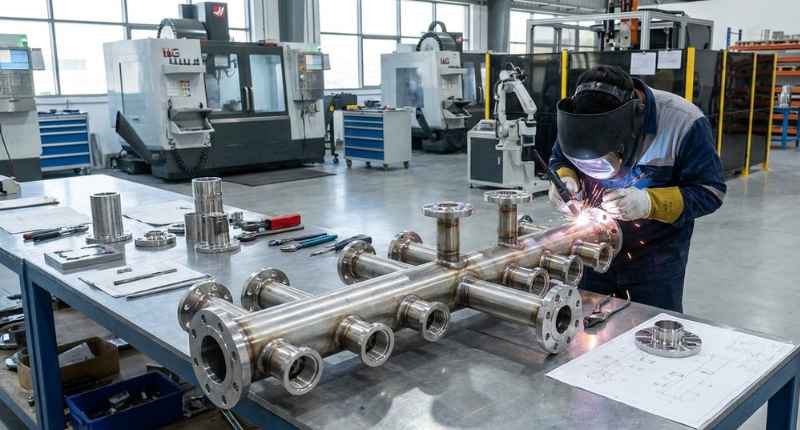
Material choice is one of the most important decisions in the industrial manifold manufacturing process.
There is no single best metal for every manifold.
Stainless steel is often selected when corrosion resistance, cleanliness, or harsh operating conditions are important.
Carbon or mild steel can provide good strength and cost control for many general industrial applications when suitable protection is used.
Brightsun states that its custom industrial manifolds can be made from stainless steel and carbon steel. The company also works with a wider range of engineering materials through its machining and fabrication operations.
For more detail, see Brightsun’s guide to materials used in CNC machining.
For custom manifold fabrication UAE, material selection should be based on the fluid, pressure, temperature, corrosion exposure, design requirement, and customer specification—not price alone.
After material approval, the physical industrial manifold manufacturing process begins.
Raw pipes, plates, blocks, fittings, and other parts are cut to the required dimensions. Depending on the design, fabrication may use sawing, machining, waterjet cutting, or other suitable methods.
Brightsun provides waterjet cutting, conventional machining, steel fabrication, welding, and pipe bending services, allowing different manufacturing steps to support the same custom project.
Cut parts must also be prepared correctly. Edges may need cleaning, beveling, facing, or deburring before machining or welding.
Accuracy here saves work later.
Machining is where many of the small but critical features are produced.
During this part of the industrial manifold manufacturing process, holes, sealing faces, ports, and threads may be machined according to the approved drawing.
Typical operations include:
Brightsun’s manufacturing capabilities include conventional and CNC machining. Its product range also covers custom fittings with ACME, NPT, BSP, metric, and JIC threads.
The correct thread type is important. A connection that looks close enough may still be completely unsuitable if the thread standard is wrong.
Buyers comparing custom manifold fabrication UAE suppliers should therefore provide connection and thread details clearly in the RFQ.
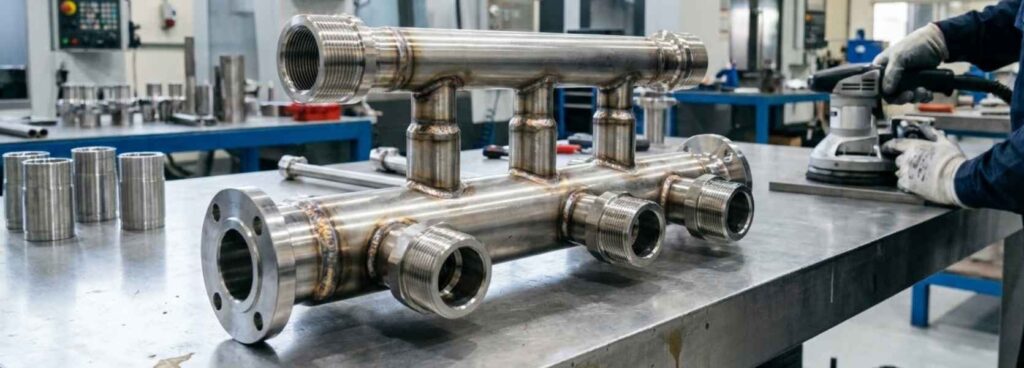
Not every industrial manifold is machined from one solid block. Fabricated manifolds can use pipes, fittings, flanges, branches, and machined components joined into one assembly.
Welding then becomes a critical stage.
The goal is not simply to make the joint look neat. Weld quality must support the specified service and testing requirements.
ASME B31.3 covers materials, design, fabrication, assembly, examination, inspection, and testing for process piping used across sectors including petroleum, chemical, power, pharmaceutical, and cryogenic plants.
The exact code or standard that applies depends on the project and service.
Brightsun offers steel fabrication and welding and states that its custom manifolds are produced with leak-resistant welds.
For custom manifold fabrication UAE, buyers should specify applicable welding, inspection, and documentation requirements before production.
A manifold can look perfect outside while still having a problem inside.
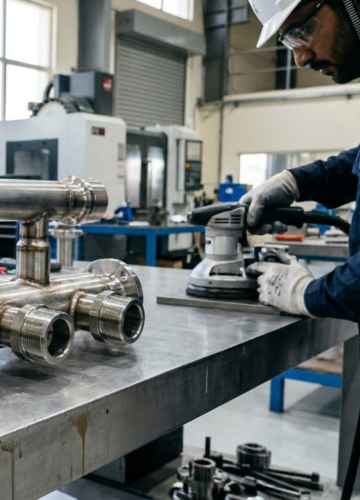
Deburring removes sharp edges, loose burrs, and excess metal left after machining or cutting.
That makes cleaning an important part of the industrial manifold manufacturing process.
Depending on the design, finishing may include:
The correct finish depends on the material and service environment.
Before testing, the manifold needs inspection.
The purpose is simple: confirm that the manufactured part matches the approved requirement.
Checks can cover:
Brightsun’s machining workflow uses tools such as calipers, micrometers, bore gauges, thread gauges, height gauges, and coordinate measuring equipment where appropriate.
A structured quality system also helps make inspection repeatable. ISO describes ISO 9001 as a globally recognized quality management standard focused on controlled processes, customer requirements, performance evaluation, and continual improvement.
Brightsun states that it operates as an ISO 9001-certified engineering workshop. Learn more in its ISO 9001 metal fabrication guide.
This is one of the most important stages of the industrial manifold manufacturing process.
A manifold may have the right dimensions and still fail to seal correctly. Testing helps verify integrity before the unit enters service.
The exact test method and pressure should follow the approved project specification and applicable standard. It should not be selected from a generic rule.
For example, ASME B31.3 includes specific requirements for examination, inspection, and testing of applicable process piping. Requirements vary with the system, material, service, and test method.
Brightsun states that its custom manifolds can be pressure tested based on customer requirements.
For custom manifold fabrication UAE, buyers should agree on the test pressure, medium, hold requirements, acceptance criteria, and required records before fabrication begins.
The final industrial manifold manufacturing process stage is release for delivery.
Ports should be protected against dirt and damage. Identification and documentation should also match the project requirement.
Depending on the order, documents may include material records, dimensional reports, inspection documents, test records, or other customer-requested certificates.
This final check is especially useful for industrial projects where traceability matters.
A custom manifold should solve a specific system problem. That is why sending only a rough sketch can create delays.
For faster custom manifold fabrication UAE, prepare a clear RFQ containing:
Not sure what information a fabricator needs? Brightsun’s guide on getting an accurate fabrication quote explains how better project information can improve quoting.
A reliable industrial manifold manufacturing process also means knowing what can go wrong.
Common risks include incorrect port positions, wrong thread types, unsuitable material, trapped machining burrs, poor weld preparation, contamination, and unclear testing requirements.
One simple way to reduce these risks is to freeze the approved drawing and technical requirements before production.
Last-minute changes may require new machining, replacement material, or rework.
For UAE buyers, choosing a supplier with machining and fabrication capabilities under one roof can also reduce handoffs between different workshops.
Brightsun explains the wider benefits of purpose-built work in its guide to custom fabrication in Dubai.
Price matters, but it should not be the only factor.
When comparing custom manifold fabrication UAE providers, ask whether the workshop can understand drawings, work with the required materials, machine the specified connections, carry out suitable welding, inspect critical dimensions, and perform the required tests.
Also ask:
These questions reveal much more than a price per piece.
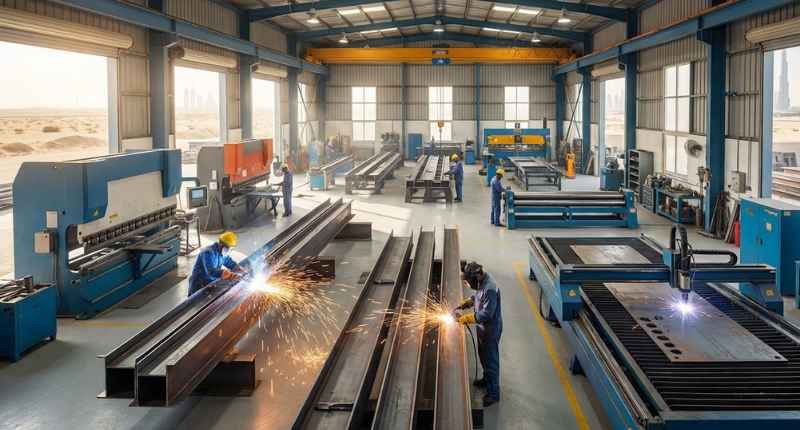
Brightsun has been active in the UAE since 2006 and operates an engineering workshop in Dubai Investments Park.
Its capabilities cover CNC and conventional machining, metal fabrication, welding, waterjet cutting, pipe bending, custom fittings, and other made-to-order industrial parts.
For manifolds, Brightsun can produce customized inlet, outlet, and instrumentation arrangements in stainless steel and carbon steel, with leak-resistant welding and pressure testing based on project requirements.
This combined capability makes custom manifold fabrication UAE easier when a project needs both machining and fabrication work.
A reliable manifold is the result of many small decisions made correctly. Material selection, port layout, machining, welding, cleaning, inspection, and testing all play a role in the industrial manifold manufacturing process.
Looking for reliable custom manifold fabrication UAE services? Contact Brightsun today to discuss your drawings, specifications, and project needs.
The industrial manifold manufacturing process covers requirement review, design, material selection, cutting, machining, welding or assembly, deburring, cleaning, inspection, testing, and final release. The exact steps change according to the manifold design and its application.
There is no fixed production time. The schedule depends on design complexity, material availability, machining work, welding, inspection, testing, quantity, and required documentation. A complete drawing usually helps a manufacturer plan the job more accurately.
Stainless steel and carbon steel are common choices for fabricated industrial manifolds. The correct material depends on the fluid, pressure, temperature, corrosion exposure, applicable standard, and customer specification.
For custom manifold fabrication UAE, provide a drawing, material grade, pressure and temperature requirements, service fluid, port locations, connection sizes, thread types, quantity, testing needs, and delivery target.
Pressure or leak testing helps verify the integrity of the completed assembly under the agreed test conditions. The test method and pressure should be based on the project’s design requirements and applicable codes rather than a universal value.
Yes. Inlet and outlet locations, instrumentation ports, connection types, materials, dimensions, and mounting arrangements can be made to suit the application. Brightsun provides custom industrial manifold fabrication based on customer requirements.
Drilling and machining can leave burrs around holes and passage intersections. If loose material remains inside a fluid system, it can cause contamination or interfere with components. Careful deburring and cleaning reduce this risk.
For custom manifold fabrication UAE, check the supplier’s machining, fabrication, welding, inspection, material, and testing capabilities. Also review its quality controls and ability to work from technical drawings.
No. Some manifolds are machined from solid blocks, while others are fabricated from pipes, fittings, plates, flanges, and machined parts. The best method depends on the design, pressure, size, flow arrangement, quantity, and application.
There is no single stage that can guarantee quality. A reliable result comes from controlling the full industrial manifold manufacturing process, from the first design review through material control, machining, welding, cleaning, inspection, and final testing.
At a Glance
Related Blogs

Shed No. 10, Fresh Express Warehouse,
Road B1, Dubai Investments Park 1,
Dubai, UAE.
+971 43807099
+971 563244963
+971 503226480