- +971 43807099
- +971 563244963
- brisunco@emirates.net.ae

- Meet Us
Shed No. 10,
Fresh Express Warehouse, Road B1, DIP 1,
Dubai, UAE.
Shed No. 10,
Fresh Express Warehouse, Road B1, DIP 1,
Dubai, UAE.
New
New
Every cutting process that uses heat leaves a signature. Plasma cutting, laser cutting, oxy-fuel cutting: all of them introduce a heat-affected zone at the cut edge where the base material has been altered by the thermal cycle of the cutting process. The steel in that zone has been heated above its transformation temperature and cooled rapidly. Its microstructure has changed. Its mechanical properties are different from the parent material.
For many applications, that heat-affected zone is an acceptable trade-off for cutting speed. For others, it is a problem that compromises the integrity of the finished part before it ever goes into service. Waterjet cutting has no heat-affected zone capability precisely for those applications, and understanding when it matters and when it does not is what determines whether waterjet is the right process for your project.
At a Glance
The heat-affected zone in thermal cutting is not just a cosmetic issue. It is a metallurgical one.
When steel is heated above its transformation temperature during cutting and then cooled rapidly, the microstructure in the affected zone changes. In carbon and alloy steels, this produces a hardened martensitic layer at the cut edge that is brittle compared to the parent material. In stainless steel, rapid heating and cooling in the sensitisation temperature range causes chromium carbide precipitation at grain boundaries, reducing corrosion resistance at the cut edge. In aluminium alloys, thermal input reduces the strength of heat-treated tempers in the affected zone, creating a weaker band adjacent to the cut.
These are not theoretical concerns. A hardened edge on a carbon steel plate that will be welded, formed, or used as a reference surface creates practical problems. A sensitised zone on a stainless steel cut edge in a corrosive service environment creates a preferential corrosion path. A softened zone on a heat-treated aluminium component reduces the load-carrying capacity of the part in the region where it was cut.
For more detail on waterjet performance with thick sections and the practical limits of cutting heavy plate, see waterjet cutting for thick metal plates.
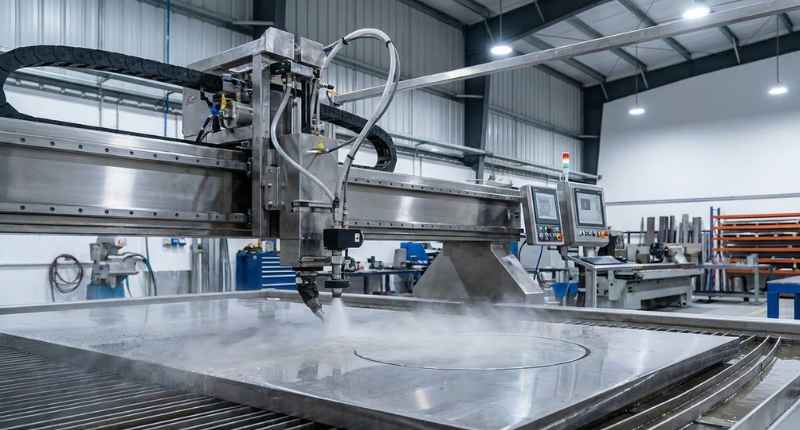
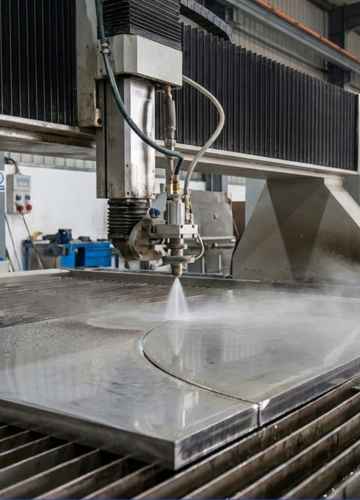
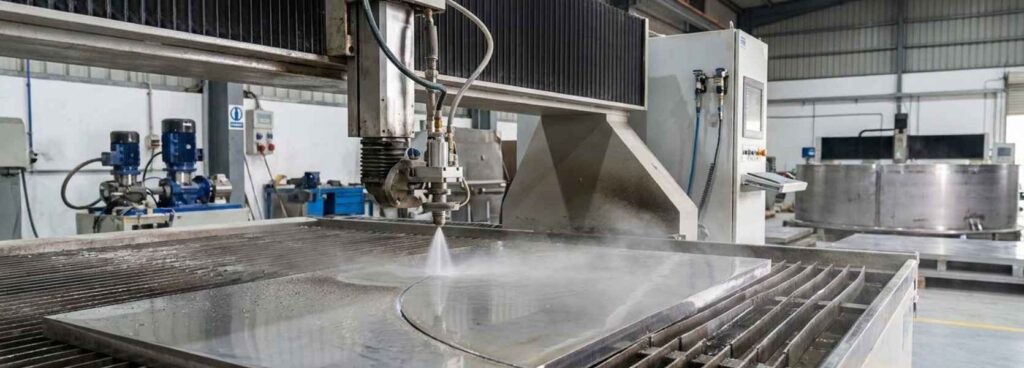
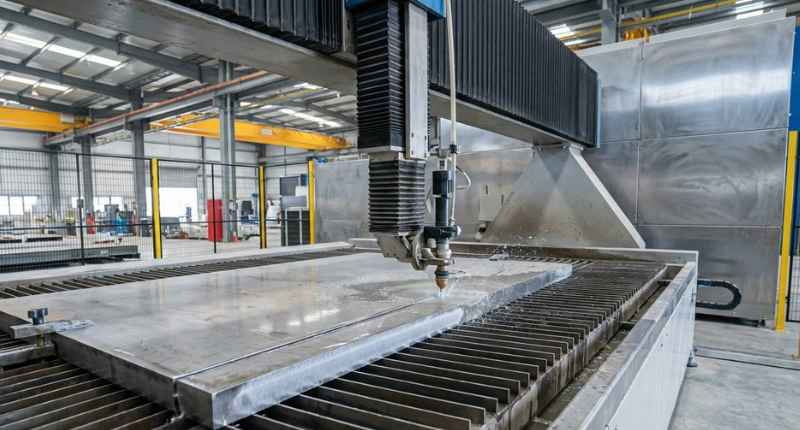
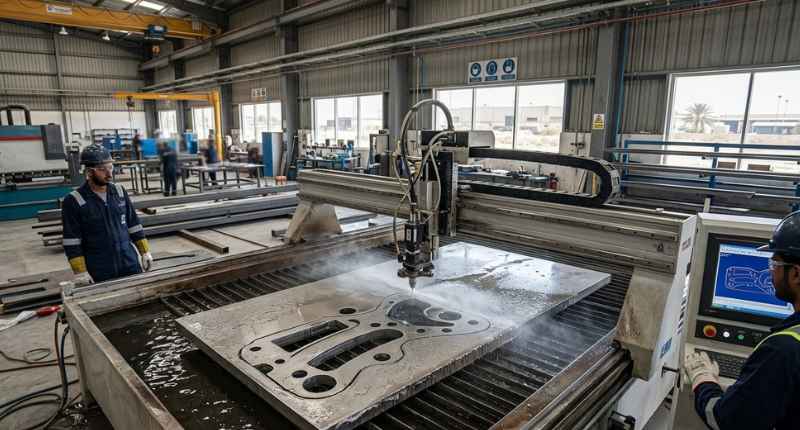
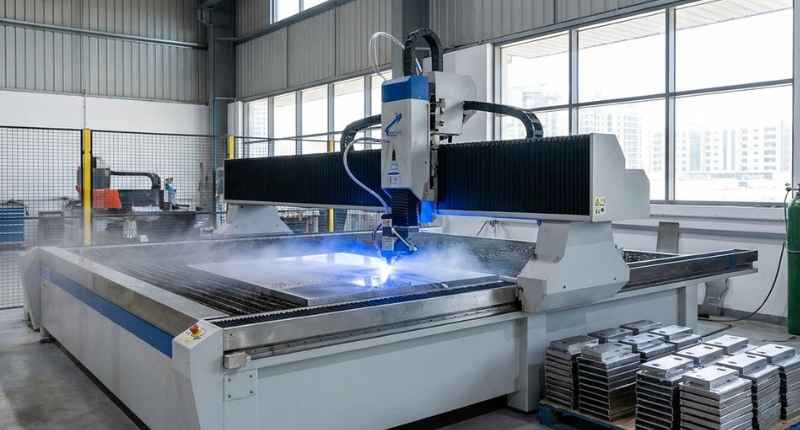
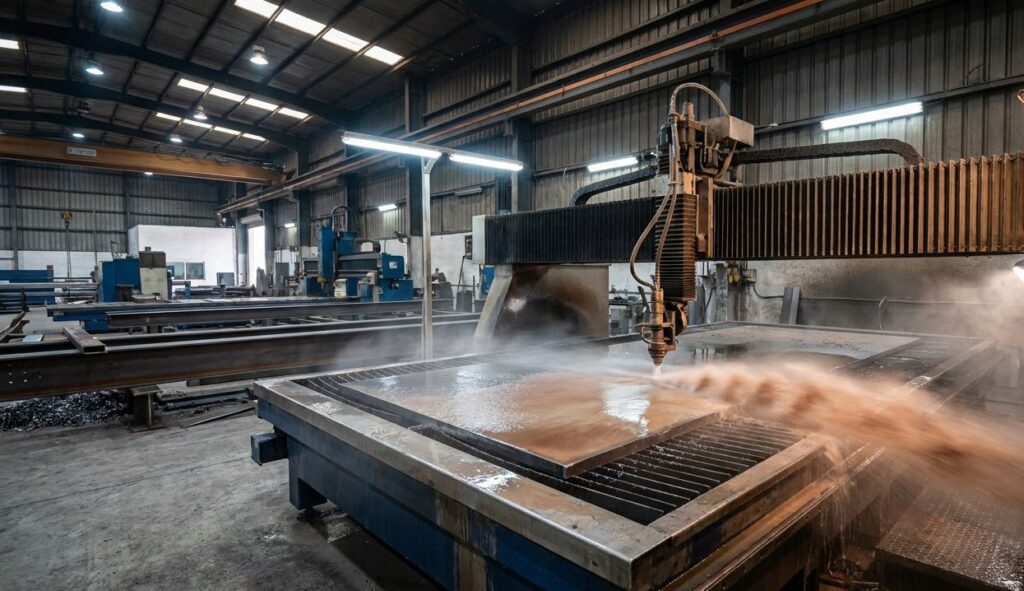
Waterjet cutting removes material through erosion, not through thermal energy. A high-pressure water stream, typically at pressures between 3,800 and 6,200 bar, is forced through a small orifice to produce a coherent jet travelling at speeds approaching the speed of sound. When abrasive garnet particles are added to the stream for cutting hard materials, the jet erodes the material along the programmed cutting path without generating significant heat at the cut surface.
The temperature at the cut zone during waterjet cutting stays below 50 degrees Celsius in most applications. That is cool enough that the operator can touch the cut edge immediately after the cut is complete. It is also cool enough that none of the metallurgical changes associated with thermal cutting occur. The material at the cut edge has the same microstructure, the same hardness, and the same corrosion resistance as the parent material away from the cut. That is the waterjet cutting no heat-affected zone advantage, and it is the reason the process is specified for applications where material integrity at the cut edge is a design requirement.
The cold cutting process benefits UAE industrial and fabrication clients depend on are most significant in four application areas.
These material-integrity advantages are especially relevant across waterjet cutting applications in industries involving oil and gas, construction, precision fabrication, and other demanding industrial projects.
Hardened and heat-treated materials are the clearest case. Tool steel, hardened wear plate, and precipitation-hardened stainless steel all have their properties defined by a controlled heat treatment process. Any subsequent thermal cutting partially reverses that heat treatment in the affected zone. Waterjet cutting produces a cut edge in hardened material that retains the full hardness and toughness of the heat-treated parent material right to the cut edge. For wear components, tooling, and high-strength structural parts, this is not a marginal improvement. It is the difference between a part that performs as designed and one that fails prematurely at the cut edge.
Stainless steel for corrosive service is the second major application. In oil and gas, chemical processing, food production, and marine environments across the UAE, stainless steel components are specified because of their corrosion resistance. Thermal cutting of stainless steel sensitises the cut edge and destroys the corrosion resistance of the material in that zone. A stainless component with thermally cut edges installed in a chloride-containing environment will show preferential corrosion at the cut edges within months of commissioning. Waterjet cutting preserves the full corrosion resistance of the stainless grade to the cut edge, which is why it is the specified cutting process for stainless components in demanding corrosive service applications.
Composite and layered materials are a third category where waterjet cutting has no equivalent in thermal processes. Carbon fibre reinforced polymers, fibreglass, rubber-lined steel, and clad plate all contain materials that thermal cutting either burns, delaminates, or selectively melts. Waterjet cuts through all of these without differential heat input, producing a clean cut edge across the full material stack.
Precision parts where the cut edge is a functional surface represent the fourth application. Gasket materials, sealing plates, wear pads, and structural connection plates where the cut edge will be in contact with another surface under load need a cut edge that is geometrically accurate and metallurgically unaltered. Waterjet cutting produces that edge directly from the cutting process without requiring secondary operations to remove heat-affected material.
Learn more about the Benefits of Waterjet Cutting for Industrial Projects and how cold cutting can support material integrity and reduce secondary work.
The absence of a heat-affected zone is the primary technical advantage of waterjet cutting, but it is not the only one. Waterjet cutting also produces dimensional accuracy and edge quality that thermal processes cannot match on most materials.
Dimensional tolerances of plus or minus 0.1mm are achievable on standard waterjet cutting setups. On precision waterjet systems with dynamic compensation for jet lag and taper, tolerances of plus or minus 0.025mm are achievable on thinner materials. These tolerances are significantly tighter than plasma cutting, which typically produces cut-to-cut variation of plus or minus 0.5mm to plus or minus 1.5mm depending on material thickness and machine condition.
Cut edge taper is present in waterjet cutting but is controllable. On standard cutting, the jet produces a slight taper of one to two degrees on the cut edge, with the top of the cut slightly wider than the bottom. On systems with tilting cutting heads, this taper is compensated by angling the cutting head to produce a truly vertical cut edge. For parts where edge squareness is a functional requirement, such as sealing surfaces and precision structural connections, taper compensation is the correct specification.
Surface finish on waterjet-cut edges is typically in the range of Ra 1.6 to Ra 6.3 depending on material, thickness, and cutting speed. Slower cutting speeds produce finer surface finishes. For parts where the cut surface finish is a functional requirement, adjusting the cutting speed is a practical way to meet the finish specification without secondary grinding or machining operations.
Waterjet cutting’s no heat-affected zone capability comes with trade-offs that determine where it belongs in a cutting process selection.
Speed is the primary trade-off. Waterjet cutting is slower than plasma and laser cutting on most materials and thicknesses. For projects where only a small number of parts are required, the higher process time can be evaluated alongside material savings and other factors discussed in cost-effective waterjet cutting for small batch orders. On thin mild steel plate up to 6mm, laser cutting is significantly faster. On medium-thickness plate from 6mm to 25mm, plasma cutting is faster on carbon steel where the heat-affected zone is acceptable. The speed penalty of waterjet cutting is the cost of the cold cutting process benefit, and it is most justified when the material or application makes the heat-affected zone an unacceptable outcome.
For a broader comparison of cutting speed, material thickness, heat effects, and application suitability, see Waterjet Cutting vs Laser Cutting: Which is Better for Industrial Use?
Kerf width is slightly wider on waterjet than on laser cutting for thin materials, though comparable to plasma on thicker sections. For tight nesting of parts on expensive material, the wider kerf means marginally more material waste per part.
Very thick sections beyond 150mm to 200mm in steel become progressively more difficult to cut accurately by waterjet because jet lag and taper increase with thickness. For very thick plate, other cutting methods may be more appropriate depending on the material and the edge quality required.
Waterjet cutting with no heat-affected zone is not a marketing claim. It is a metallurgical fact with direct consequences for material performance in service. For applications involving hardened materials, corrosion-resistant alloys in aggressive environments, composite materials, and precision functional cut edges, waterjet cutting preserves the material integrity that thermal cutting processes compromise.
The cold cutting process benefits UAE fabrication and industrial clients most significantly where the material properties at the cut edge matter to the performance of the finished part. In those applications, waterjet cutting is not a premium option. It is the correct process, and the alternatives produce a part that underperforms relative to the material specification.
Brightsun Industries provides waterjet cutting services in Dubai and across the UAE for clients in oil and gas, marine, food processing, and precision fabrication who need cut edges that preserve the full properties of the parent material.
Contact us to discuss your cutting requirements and material specifications.
Q1: What does waterjet cutting no heat-affected zone mean in practical terms?
It means the material at the cut edge retains the same microstructure, hardness, and corrosion resistance as the parent material away from the cut, because waterjet cutting removes material through erosion at low temperature rather than through thermal energy.
Q2: What cold cutting process benefits do UAE clients in oil and gas see from waterjet cutting?
Stainless steel and duplex alloy components cut by waterjet retain their full corrosion resistance at the cut edge, eliminating the preferential corrosion path that thermal cutting creates through sensitisation in the heat-affected zone.
Q3: Can waterjet cutting be used on hardened steel without affecting its hardness?
Yes, waterjet cutting produces a cut edge in hardened steel that retains the full hardness and toughness of the heat-treated parent material, because the process generates no significant heat at the cut zone.
Q4: What dimensional tolerances does waterjet cutting achieve compared to plasma cutting?
Standard waterjet cutting achieves tolerances of plus or minus 0.1mm, and precision systems with taper compensation achieve plus or minus 0.025mm on thinner materials, compared to plasma cutting, which typically produces variation of plus or minus 0.5mm to plus or minus 1.5mm.
Q5: Why is waterjet cutting specified for stainless steel components in corrosive service?
Thermal cutting of stainless steel sensitises the cut edge through chromium carbide precipitation, destroying corrosion resistance in the heat-affected zone, while waterjet cutting preserves the full corrosion resistance of the stainless grade to the cut edge.
Q6: What materials can the waterjet cutting process handle that thermal cutting cannot?
Composite materials including carbon fibre reinforced polymers, fibreglass, rubber-lined steel, and clad plate can all be waterjet cut cleanly across the full material stack, whereas thermal cutting burns, delaminates, or selectively melts different material layers.
Q7: What is the main trade-off of waterjet cutting compared to plasma or laser cutting?
Waterjet cutting is slower than plasma and laser cutting on most materials and thicknesses, and the speed penalty is the cost of the cold cutting process benefit that preserves material integrity at the cut edge.
Q8: Does waterjet cutting produce a tapered cut edge, and does it matter?
A slight taper of one to two degrees is present on standard waterjet cuts, but cutting systems with tilting heads compensate for this taper to produce a vertical cut edge where squareness is a functional requirement such as sealing surfaces and precision connections.
Q9: What surface finish does waterjet cutting produce on the cut edge?
Waterjet cutting produces surface finishes in the range of Ra 1.6 to Ra 6.3 depending on material, thickness, and cutting speed, with slower speeds producing finer finishes that can meet surface requirements without secondary grinding operations.
Q10: When is waterjet cutting not the right cutting process despite its cold cutting benefits?
Waterjet cutting is less appropriate for thin mild steel where laser cutting is faster, and the heat-affected zone is acceptable for the application, and for very thick sections beyond 150mm to 200mm where jet lag and taper become difficult to control accurately.
At a Glance
Related Blogs

Shed No. 10, Fresh Express Warehouse,
Road B1, Dubai Investments Park 1,
Dubai, UAE.
+971 43807099
+971 563244963
+971 503226480