- +971 43807099
- +971 563244963
- brisunco@emirates.net.ae

- Meet Us
Shed No. 10,
Fresh Express Warehouse, Road B1, DIP 1,
Dubai, UAE.
Shed No. 10,
Fresh Express Warehouse, Road B1, DIP 1,
Dubai, UAE.
New
New
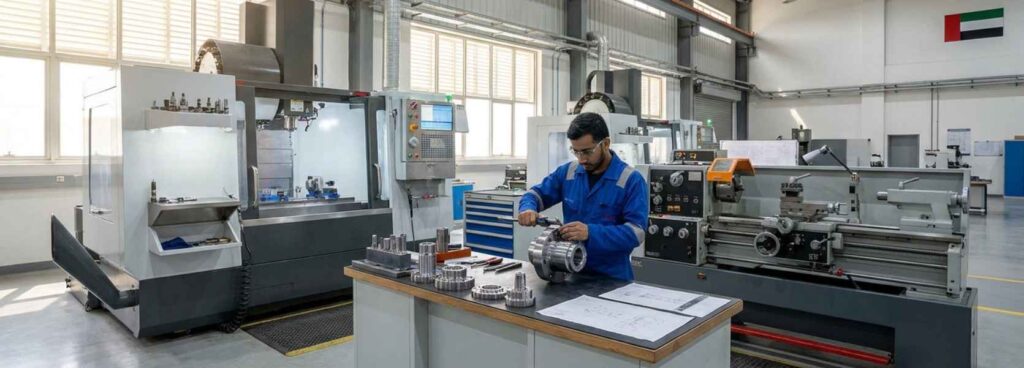
Most procurement managers in UAE factories assume this is a settled debate. CNC wins. The manual is obsolete. Move on.
That is not the full picture.
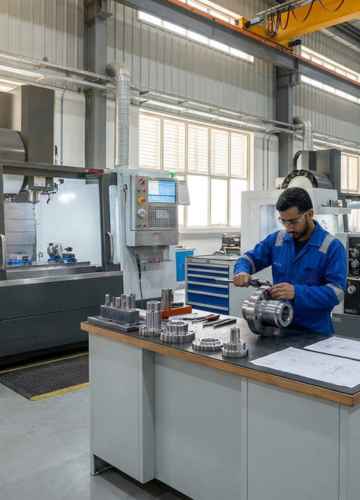
Manual machining is not dead in UAE workshops. It is not even dying. It is doing specific work that CNC handles poorly, at a cost that CNC cannot match for that work. The factories getting this wrong are the ones specifying CNC for every job because it sounds more advanced, and paying the setup costs to prove it.
This guide is for maintenance engineers, plant managers, and procurement teams who need to understand the real difference between CNC machining and manual machining, where each one belongs, and what the precision machining comparison UAE buyers actually need to make smarter decisions on the shop floor.
At a Glance
CNC machining runs the same programmed toolpath on every part. No operator variation. No fatigue. No interpretation. The tenth part of the machine is identical to the first.
That consistency is the core value of CNC. For production runs, repeat orders, and parts with tight tolerances across multiple features, CNC delivers accuracy and repeatability that manual machining cannot match at volume. A CNC turning centre running a batch of 50 identical shaft components will hold tighter tolerances across the batch than any manual lathe operator working the same job over an eight-hour shift.
If you’re new to CNC technology, start with our What is CNC Machining and How Does It Work? Complete Guide, which explains the complete CNC workflow from CAD design and G-code programming to final inspection before comparing it with manual machining.
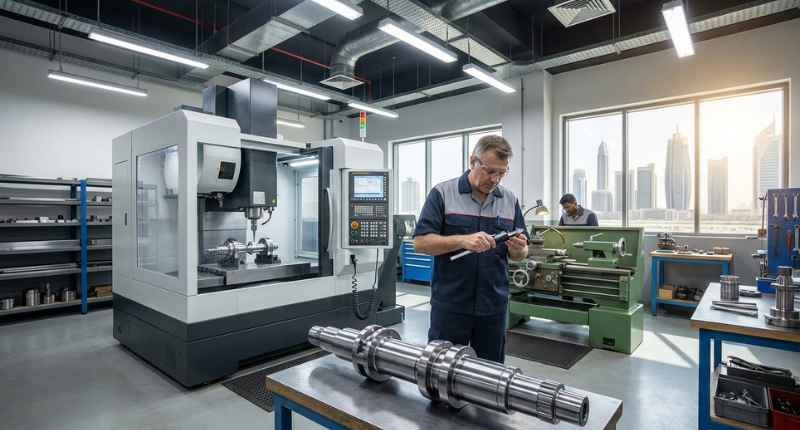
A skilled manual machinist makes decisions in real time. They feel the cut. They hear the chatter. They adjust feed rate and depth of cut based on what the material is doing, not what a program says it should be doing.
For one-off repairs, emergency part production, and jobs where the geometry is simple and the setup time for CNC programming would exceed the actual cutting time, manual machining is faster and cheaper. A single replacement pin, a quick facing operation on a damaged flange, a minor shaft repair that needs two passes on a lathe: these are manual jobs. Running them through a CNC setup process adds cost and time without adding quality.
CNC machining requires a program. Writing that program takes time. For a complex part with multiple features and tight tolerances, that programming investment is recovered across the batch. For a single simple part, the programming time can exceed the machining time.
Manual machining has almost no setup cost for simple operations. An experienced machinist can pick up a worn shaft, measure it, set the lathe, and start cutting within minutes. That speed is genuinely valuable in emergency repair scenarios, which is exactly the context UAE industrial facilities encounter most often when they need a single replacement part at short notice.
Want to see how a CNC component is actually manufactured? Read our Step-by-Step CNC Machining Process: From CAD File to Finished Part for a detailed walkthrough of every production stage, from project review and CAD modelling to machining, finishing, and quality inspection.
CNC machining holds tighter tolerances more consistently. A CNC lathe running to a qualified program will hold plus or minus 0.01mm across a production batch without operator intervention. That level of consistency is what precision components in pumps, gearboxes, and compressors require.
Manual machining in skilled hands can achieve tight tolerances on individual features. Plus or minus 0.025mm is achievable on a well-maintained manual lathe with an experienced operator. But holding that tolerance across 20 identical parts requires sustained concentration across the full batch, and tolerance drift increases as the shift progresses. For single parts and small batches, the practical precision difference between CNC and manual is smaller than most buyers assume.
The relevant comparison for most UAE factories is not CNC versus manual in the abstract. It is CNC versus manual for the specific job in front of them.
A production run of 30 identical gearbox components: CNC. A single emergency replacement bushing is needed in two hours: manual. A complex multi-feature part with tight tolerances on every surface: CNC. A simple shaft repair involving two diameter steps and a keyway on a part that is already in the machine: manual. The decision framework is not about which technology is better. It is about which one produces the right part at the right time for the right cost on this specific job.
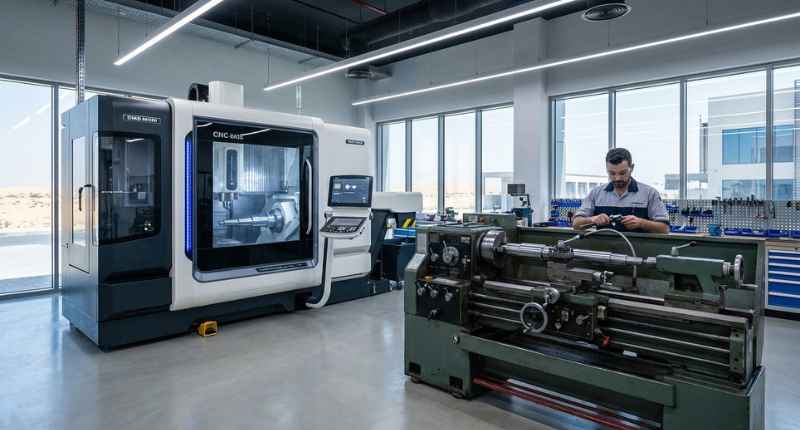
The most common mistake is applying CNC to every job because the shop has invested in CNC equipment and wants to utilise it. Setup costs get absorbed into the job price without the buyer noticing, because the quote looks like a single number. The actual machining time on a simple part might be 20 minutes. The programming and setup time might be two hours. That ratio makes no sense for a one-off repair part.
The second mistake is the opposite. Shops without CNC capability default to manual machining on jobs where CNC is genuinely needed, and the result is tolerance variation across a batch that creates assembly problems downstream. Both mistakes cost money. The first inflates repair costs unnecessarily. The second creates rework and field failures.
CNC machining produces a consistent surface finish across every part because the cutting parameters are fixed in the program. For components where surface finish affects function, such as bearing seats, sealing surfaces, and gear tooth flanks, CNC consistency is directly linked to component performance.
Manual machining produces a surface finish that varies with operator technique and tool condition. On non-critical surfaces, this does not matter. On sealing faces and precision fits, it does. Feature complexity also favours CNC. Producing a part with five diameter steps, two keyways, cross-drilled holes, and a threaded bore on a manual machine requires multiple setups and careful operator attention at each stage. On a CNC turning centre with live tooling, the same part runs in a single setup from one program.
Different machining operations require different equipment. Explore our guide on Types of CNC Machines Used in Dubai Workshops: Lathes, Mills & Routers to understand which machines are best suited for turning, milling, grinding, routing, and other industrial applications.
Along with choosing the right machining method, selecting the appropriate material significantly impacts strength, surface finish, corrosion resistance, and production cost. Read our Materials Used in CNC Machining: Aluminum, Steel, Brass & Plastics guide for a complete comparison of commonly used CNC materials.
The right answer for most UAE industrial workshops is not CNC or manual. It is both, applied to the right jobs. A workshop with CNC turning and milling for production and precision work, alongside conventional lathes and mills for emergency repairs and simple one-off parts, covers the full range of what industrial clients actually need.
Workshops that have retired all manual equipment in favour of CNC create a bottleneck on simple emergency jobs where CNC setup costs make the work uneconomical. Workshops with only manual equipment cannot deliver the tolerance consistency and production efficiency that repeat production work requires. The shops that serve UAE industrial clients most effectively are the ones that have made both investments and know which tool to reach for on each job.
Once you understand the strengths of each machining method, our How to Choose a CNC Machining Company in Dubai: Checklist for Buyers will help you assess whether a supplier has the right capabilities, quality systems, and experience for your project.
CNC machining vs manual machining is not a competition with a universal winner. It is a decision framework that should be applied job by job based on batch size, part complexity, tolerance requirements, and lead time.
For UAE factories managing both production machining requirements and emergency breakdown repairs, the right machining partner is one who operates both capabilities and has the experience to deploy each one correctly. The precision machining comparison UAE buyers should be making is not which technology the shop has invested in. It is whether the shop knows when to use each one.
Brightsun Industries operates CNC and conventional machining capabilities from its Dubai workshop, supporting UAE industrial clients across production machining, emergency part replacement, and reverse engineering requirements.
Contact us through this contact form to discuss your machining requirements and lead time expectations.
Q1: What is the main difference between CNC machining and manual machining?
CNC machining runs a pre-programmed toolpath automatically on every part, delivering consistent tolerances across production batches, while manual machining relies on operator skill and real-time adjustment, which suits one-off parts and simple emergency repairs better.
Q2: Which is more accurate, CNC or manual machining?
CNC machining holds tighter tolerances more consistently across a batch, with plus or minus 0.01mm achievable on qualified CNC programs, while manual machining in skilled hands can achieve plus or minus 0.025mm on individual features but struggles to maintain that consistency across multiple identical parts.
Q3: When does manual machining make more sense than CNC in UAE workshops?
Manual machining makes more sense for single replacement parts, simple emergency repairs, and jobs where the CNC programming and setup time would exceed the actual cutting time, making it faster and cheaper for the specific scope.
Q4: What does a precision machining comparison UAE buyers should make actually look like?
The comparison should be made job by job based on batch size, part complexity, tolerance requirements, and lead time rather than defaulting to CNC for everything or avoiding it because the shop lacks the capability.
Q5: Can manual machining hold the same tolerances as CNC machining?
A skilled manual machinist can hold tight tolerances on individual features, but maintaining that consistency across a batch of identical parts is where manual machining falls short compared to CNC, which runs the same program on every part without operator fatigue or variation.
Q6: Why do some UAE workshops still use manual machining alongside CNC?
Manual machining handles simple one-off jobs and emergency repairs faster and more cost-effectively than CNC because it requires no programming or complex setup, making it a practical complement to CNC capability rather than a technology to be replaced by it.
Q7: What types of parts are best suited to CNC machining in UAE factories?
Production batches of identical parts, complex multi-feature components with tight tolerances on multiple surfaces, and parts requiring consistent surface finish on functional surfaces like bearing seats and sealing faces are all best suited to CNC machining.
Q8: How does setup time affect the cost of CNC vs manual machining for small jobs?
CNC programming and setup time can exceed the actual cutting time on simple one-off parts, making the total cost of a CNC job significantly higher than a manual job of equivalent complexity when the batch size is too small to distribute the setup cost across multiple parts.
Q9: What should UAE factories look for in a machining partner that offers both CNC and manual capability?
Look for a workshop with qualified CNC programmers, experienced manual machinists, in-house inspection capability, and a track record of applying each method to the right job type rather than defaulting to one technology for all work.
At a Glance
Related Blogs

Shed No. 10, Fresh Express Warehouse,
Road B1, Dubai Investments Park 1,
Dubai, UAE.
+971 43807099
+971 563244963
+971 503226480