- +971 43807099
- +971 563244963
- brisunco@emirates.net.ae

- Meet Us
Shed No. 10,
Fresh Express Warehouse, Road B1, DIP 1,
Dubai, UAE.
Shed No. 10,
Fresh Express Warehouse, Road B1, DIP 1,
Dubai, UAE.
New
New
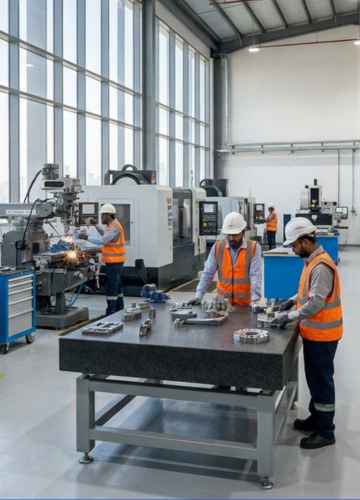
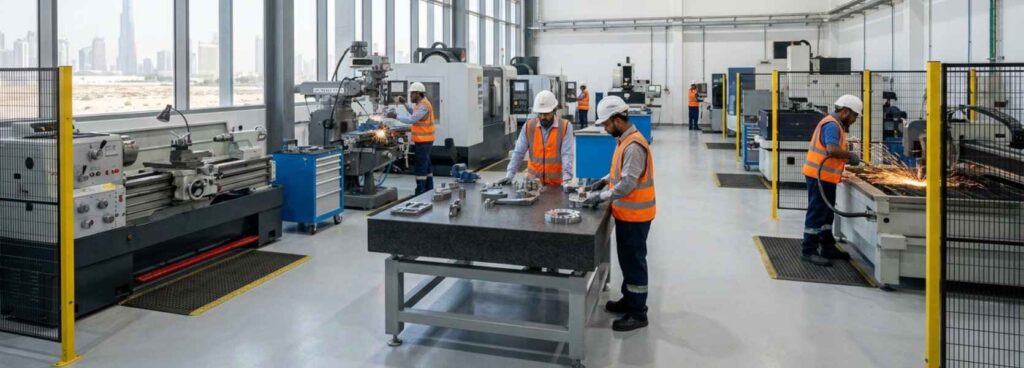
Walk into any serious CNC workshop in Dubai, and you will not find one type of machine. You will find several. Each one does something the others cannot. A lathe cannot mill a pocket. A mill cannot turn a shaft. A router cannot hold the tolerances a grinding machine can.
Understanding the types of CNC machines used in manufacturing tells you two things. What a workshop can actually produce. And whether the shop you are evaluating has the right equipment for your specific part.
This guide covers the main machine types, what each one does, and how they apply to industrial work in the UAE.
If you’re new to precision manufacturing, start with our guide on What is CNC Machining and How Does It Work? Complete Guide, which explains the CNC machining process, its key benefits, and why it is widely used across modern industries before exploring the different machine types.
At a Glance
A CNC lathe holds a workpiece and spins it. A cutting tool moves along two axes and removes material as the workpiece rotates. The result is a cylindrical part: a shaft, a pin, a bushing, a threaded component, a flanged fitting.
The lathe is the most common machine in a UAE industrial workshop. Most rotating equipment runs on shafts, and shafts break, wear, and need replacement. A CNC lathe with the right bar stock and an experienced programmer can produce a replacement shaft in hours.
Modern CNC lathes also carry driven tools, live tooling that rotates independently of the spindle. This lets the machine mill flats, drill cross holes, and cut keyways in the same setup as the turning operation. The result is a complete part off one machine without repositioning.
For industrial maintenance and repair work across Dubai, CNC lathes handle the majority of emergency part requests: shafts, journals, bearing seats, couplings, and threaded fittings that keep rotating equipment running.
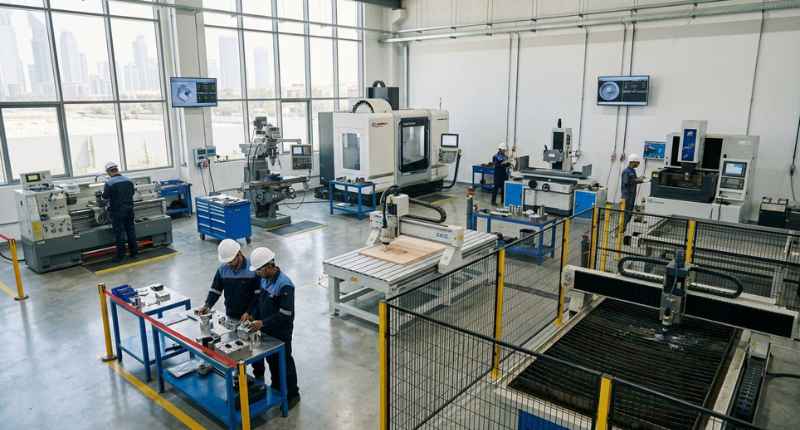
A CNC milling machine holds the workpiece stationary. The cutting tool rotates and moves across it. Material comes off in the form of chips as the tool traces the programmed path across the surface.
Mills produce features that lathes cannot. Flat faces, rectangular pockets, slots, bolt hole patterns, contoured profiles, and angular surfaces all come from milling operations. A gearbox housing, a mounting bracket, a custom flange with a non-circular bolt pattern: these are milling jobs.
A 3-axis mill moves the tool in X, Y, and Z. It handles the majority of standard industrial parts. For components with features on multiple faces or complex curved surfaces, a 4-axis or 5-axis machine adds rotational movement. The part can be approached from multiple angles in a single setup, which improves accuracy and cuts production time on complex parts.
5-axis machining is used in aerospace, oil and gas, and medical manufacturing where complex geometries need to be held to tight tolerances across multiple surfaces simultaneously. For UAE workshops serving the oil and gas sector, 5-axis capability is a meaningful differentiator on complex valve bodies, impeller components, and custom tooling.
This is the question that comes up most in procurement conversations. The answer is usually determined by the part geometry.
If the part is round and its features are concentric with a central axis, it is a turning job. If the part has flat faces, angled surfaces, or features that are not concentric with a single axis, it needs milling. Many parts need both, which is why CNC turning centres with live tooling, or mill-turn machines that combine both processes in one unit, are increasingly common in UAE workshops handling complex part orders.
The CNC lathe vs CNC mill UAE question also comes up in cost conversations. Turning is generally faster and cheaper for cylindrical parts than trying to produce them on a mill. Milling a round shaft from a square billet wastes material and machine time. The right process for the part geometry saves both.
Beyond selecting the right machine, it’s equally important to know when CNC is necessary and when manual machining is the more efficient option. Read CNC Machining vs Manual Machining: The Question UAE Factories Are Still Getting Wrong.
A CNC router looks similar to a milling machine but operates differently. Routers run at much higher spindle speeds and lighter cutting loads. They are designed for softer materials: wood, plastics, composites, aluminium sheet, and foam.
In a UAE industrial context, CNC routers appear in fabrication shops producing aluminium panels, plastic components, composite parts, and signage. They are not the right tool for steel machining or tight-tolerance work. A router that produces a clean aluminium panel at high speed will not hold the dimensional tolerances required for a bearing seat or a gear bore.
Understanding this distinction matters when evaluating a workshop. A shop that lists CNC routing as part of its capability is not the same as a shop with CNC milling and turning capacity for precision steel components.
Cutting tools remove material in chips. Grinding removes material in particles, using an abrasive wheel instead of a cutting edge. The result is a surface finish and dimensional accuracy that cutting cannot match.
Bearing seats, gauge surfaces, precision bores, and hardened components that need final sizing after heat treatment go through CNC grinding. The tolerances achievable on a grinding machine, down to a few microns, are tighter than what turning or milling can hold on most workshop equipment.
For UAE facilities producing or repairing precision components in pumps, compressors, and gearboxes, grinding capability in-house is a sign of a workshop that handles the full production sequence rather than outsourcing the finishing steps.
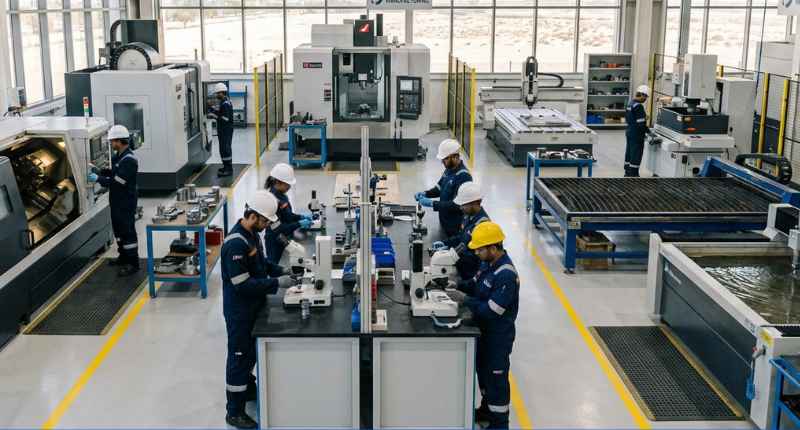
EDM stands for Electrical Discharge Machining. It removes material through controlled electrical sparks between the tool electrode and the workpiece. No cutting force is applied. The tool never touches the part.
This makes EDM the right process for hardened materials that cutting tools struggle with, for sharp internal corners that end mills cannot reach, and for intricate profiles in tool steel or exotic alloys. Wire EDM cuts complex 2D profiles through a workpiece using a thin wire electrode. Sinker EDM burns a shaped cavity into a workpiece using a machined electrode of the inverse geometry.
In the UAE, EDM is used primarily in toolmaking, die and mould production, and precision component work for oil and gas applications. It is a specialist capability that not every workshop carries.
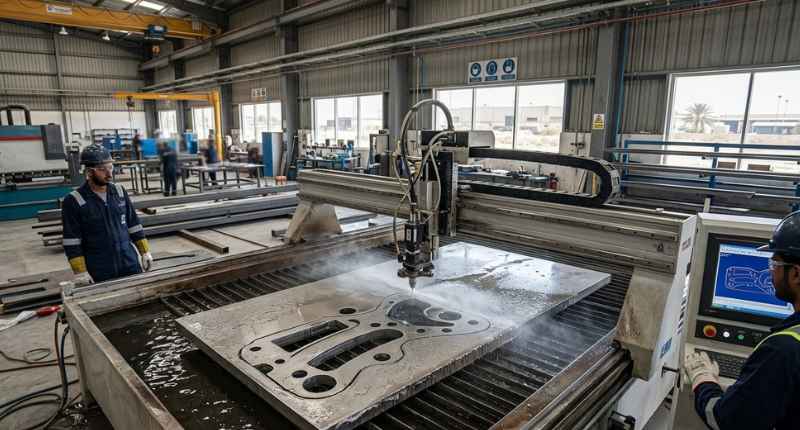
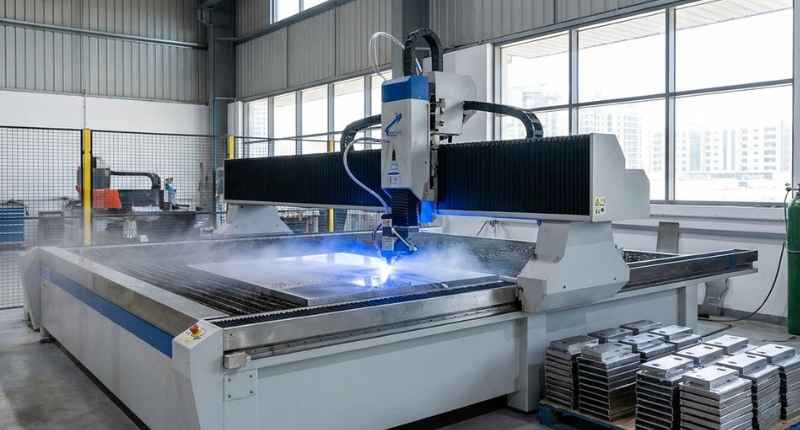
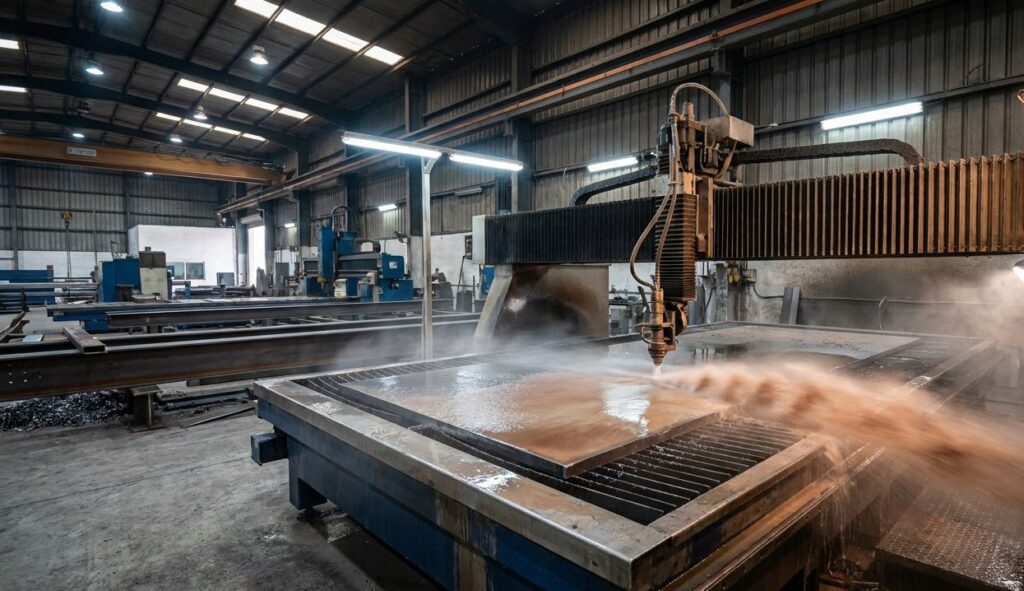
Both plasma and waterjet cutting machines produce 2D profiles cut from flat sheet or plate material. Plasma uses a high-temperature ionised gas jet to cut conductive metals quickly. Waterjet uses a high-pressure stream of water mixed with abrasive particles to cut virtually any material without heat.
The distinction matters because plasma cutting introduces a heat-affected zone at the cut edge, which changes the material properties of the steel immediately adjacent to the cut. For structural fabrication where edge quality is less critical, plasma is fast and cost-effective. For precision parts where the cut edge will be used as a reference surface or where material properties must be consistent to the edge, waterjet is the correct choice.
UAE fabrication workshops that carry waterjet cutting can produce net-shape or near-net-shape blanks for subsequent CNC machining, reducing material waste and machining time compared to cutting blanks from solid bar stock.
A workshop equipped to handle the full range of industrial CNC machining work in Dubai and across the UAE needs, at minimum: CNC turning for cylindrical parts, CNC milling for prismatic and complex parts, grinding for tight-tolerance finishing, and cutting capability for plate and sheet profiling.
Workshops that cover this range in-house can take a part from raw material to finished, inspected component without subcontracting any stage of the process. That matters for lead time, quality control, and accountability when something needs to be corrected.
For emergency repair and replacement part work, the ability to move a job from one machine to the next without waiting on a subcontractor is often what determines whether a part arrives in two days or two weeks.
Understanding the different CNC machines is only part of the manufacturing process. Our Step-by-Step CNC Machining Process: From CAD File to Finished Part shows how these machines are used throughout the complete production workflow, from CAD design and machine setup to precision machining and final inspection.
Selecting the right CNC machine is only part of the equation. Material properties also determine machining performance and finished part quality. Explore our guide on Materials Used in CNC Machining: Aluminum, Steel, Brass & Plastics to understand which materials best suit different manufacturing applications.
Having the right machines is only one part of supplier selection. Read our How to Choose a CNC Machining Company in Dubai: Checklist for Buyers to learn what else to evaluate before choosing a machining partner.
For industrial buyers in the UAE evaluating CNC machining partners for precision parts, emergency replacements, or ongoing production, matching your part requirements to the right machine type is the starting point.
The workshop that has the right equipment, the right programming capability, and the right quality systems around both is the one that will deliver consistently when it matters.
Brightsun Industries operates CNC turning, milling, and machining services from its Dubai workshop, serving industrial clients across oil and gas, marine, construction, and manufacturing with precision-machined parts, emergency replacements, and reverse-engineered components.
Contact Brightsun Industries to discuss your part requirements and lead time expectations. Here is the link to our contact form.
Q1: What are the main types of CNC machines used in manufacturing? The main types are CNC lathes for cylindrical parts, CNC mills for flat and complex profiles, CNC grinders for tight-tolerance finishing, CNC EDM for hardened materials and intricate features, and CNC routers for softer materials like plastics and composites.
Q2: What is the difference between a CNC lathe and a CNC mill in UAE workshops? A CNC lathe rotates the workpiece to produce cylindrical parts like shafts and bushings, while a CNC mill rotates the cutting tool across a stationary workpiece to produce flat surfaces, pockets, slots, and complex profiles.
Q3: When does a part need both turning and milling? Parts with a cylindrical body but non-concentric features like keyways, cross-drilled holes, or milled flats need both turning and milling, which is why mill-turn machines that combine both processes in one setup are common in UAE precision workshops.
Q4: What is 5-axis CNC machining and when is it needed? 5-axis CNC machining moves the cutting tool across five axes simultaneously, allowing complex curved surfaces and multi-face features to be produced in a single setup without repositioning, which is needed for components like impellers, valve bodies, and aerospace parts.
Q5: What is the difference between CNC plasma cutting and waterjet cutting? Plasma cutting uses heat to cut conductive metals quickly but introduces a heat-affected zone at the cut edge, while waterjet cutting uses high-pressure abrasive water to cut any material without heat, preserving material properties to the cut edge.
Q6: Can a CNC router be used for precision steel machining in UAE workshops?
No, CNC routers are designed for softer materials like wood, plastics, and aluminium sheet and do not hold the dimensional tolerances required for precision steel components like bearing seats or gear bores.
Q7: What is CNC grinding and why is it a separate process from milling?
CNC grinding uses an abrasive wheel to remove material in particles rather than chips, achieving surface finishes and tolerances down to a few microns that cutting tools used in milling and turning cannot reach.
Q8: What is EDM machining used for in UAE industrial workshops?
EDM is used for cutting hardened materials, producing sharp internal corners, and machining intricate profiles in tool steel and exotic alloys where conventional cutting tools cannot reach or where no cutting force can be applied to the workpiece.
Q9: How do I know which CNC machine type is right for my part?
If the part is cylindrical with features on a central axis, it is a turning job. If it has flat faces, pockets, or angular surfaces, it needs milling. Parts with both feature types need a mill-turn machine or two separate setups across both machine types.
Q10: What should I look for in a CNC machining workshop in Dubai for emergency part production?
Look for a workshop with in-house turning, milling, and grinding capability, stock material in common grades, ISO 9001 certification, and a track record of reverse engineering replacement parts for industrial equipment at short notice.
At a Glance
Related Blogs

Shed No. 10, Fresh Express Warehouse,
Road B1, Dubai Investments Park 1,
Dubai, UAE.
+971 43807099
+971 563244963
+971 503226480