- +971 43807099
- +971 563244963
- brisunco@emirates.net.ae

- Meet Us
Shed No. 10,
Fresh Express Warehouse, Road B1, DIP 1,
Dubai, UAE.
Shed No. 10,
Fresh Express Warehouse, Road B1, DIP 1,
Dubai, UAE.
New
New
This is the most common complaint from procurement teams managing metal fabrication projects in Dubai. The initial quote was competitive. The supplier was selected. Then the invoices started arriving with line items that were not on the original document.
Understanding the hidden costs in metal fabrication projects before the order is placed is what separates buyers who stay on budget from those who spend the back half of a project explaining variances to management. This guide covers the cost items that consistently catch UAE clients off guard and what to do about each one before fabrication begins.
Some hidden costs come from choosing the wrong fabrication approach in the first place. Our guide on Custom vs Standard Metal Fabrication Cost in the UAE explains when a higher upfront custom solution actually reduces total project costs.
At a Glance
Most fabrication quotes in Dubai are valid for 30 days. Steel prices move faster than that in an active market. What catches buyers off guard is not the validity period itself but the escalation clause buried in the supplier’s terms and conditions that allows the fabricator to adjust the material component of the price if procurement is delayed beyond the quote validity.
On large structural fabrication jobs where material represents 50% to 60% of the total cost, a 10% steel price movement between quote and order placement translates directly into a 5% to 6% total project cost increase. Ask every fabrication supplier to confirm whether their quote is fixed price or subject to material escalation, and get the answer in writing before award.
Once you understand how steel price movements affect budgets, compare them with the latest Steel Fabrication Cost per Kg in Dubai 2026 to benchmark fabrication rates before requesting quotations.
Before requesting or comparing quotations, providing complete project information can help prevent pricing assumptions and revisions. Learn what details are needed to get an accurate metal fabrication quote Dubai.
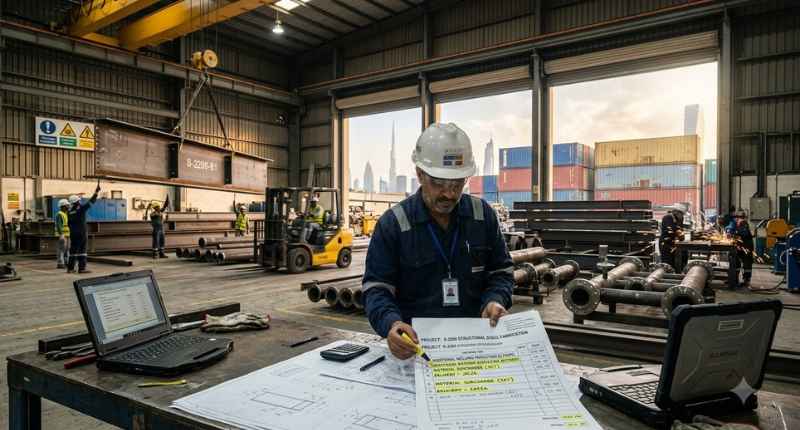
Fabrication quotes are built on the weight of finished steel in the completed assembly. The material actually purchased to produce that assembly is always more, because cutting, forming, and welding generate waste that is not part of the finished product.
Standard cutting waste assumptions run from 10% to 25% depending on part geometry and nesting efficiency. On simple structural sections cut to length, waste is minimal. On complex plate profiles with irregular shapes, waste can reach 25% or more of the purchased material. Some fabricators include this waste in their quoted price. Others quote on finished weight and add the waste factor to the material purchase order separately.
Ask explicitly whether the quote is based on finished weight or purchased weight. The difference on a 10-tonne fabrication job at current steel prices is not a rounding error.
Most fabrication contracts place the cost of rework on the fabricator when a defect is identified during production. In practice, this is more complicated. Rework that is identified late in the fabrication sequence, after painting, assembly, or third-party inspection, generates costs beyond just the re-fabrication of the defective item.
Re-blasting and repainting a completed assembly because a weld defect was found after surface treatment has been applied costs more than fixing the weld before surface treatment. Delays caused by rework on critical path items generate costs that fall on the client in the form of extended site programmes and delayed commissioning. These costs do not appear on a fabrication invoice. They appear in the project programme and in downstream contract penalties.
The way to avoid this is not to accept lower inspection standards. It is to verify that the fabricator has in-process inspection built into their production sequence, catching defects before they become expensive to fix.
Many fabrication quotes exclude third-party inspection costs entirely, particularly when the client has not specified an inspection requirement in the enquiry. When the client later introduces a third-party inspector, the fabricator charges for witness hold points, re-inspection after rework, and the additional documentation required to support the inspection process.
On coded pressure vessel and piping work, third-party inspection fees from bodies like Bureau Veritas, Lloyd’s Register, or DNV can add 3% to 8% to the total fabrication cost depending on the scope and the number of witness points required. This is not a cost that can be avoided on safety-critical work. It is a cost that should be in the budget from day one, not discovered after award.
Surface preparation and coating is one of the most common areas where scope gaps between the client’s expectation and the fabricator’s quote create disputes and additional costs.
A quote that references primer coat does not necessarily include surface preparation to Sa 2.5 blast standard. A quote that includes one coat of primer does not include an intermediate coat or a topcoat. A quote that covers shop primer does not include field touch-up after installation damage. Each of these gaps is a legitimate additional cost if it was not included in the original scope, and each one is avoidable if the coating specification is written in full before the enquiry goes out.
Specify the full coating system by standard, not by generic description. Sa 2.5 blast, 75 micron zinc-rich primer, 125 micron epoxy intermediate, 75 micron polyurethane topcoat is a specification. Painted as per standard is not.
Surface treatment is only one part of the pricing equation. Our guide on Factors That Affect Metal Fabrication Cost in the UAE breaks down how material choice, design complexity, labour, and finishing influence the final quote.
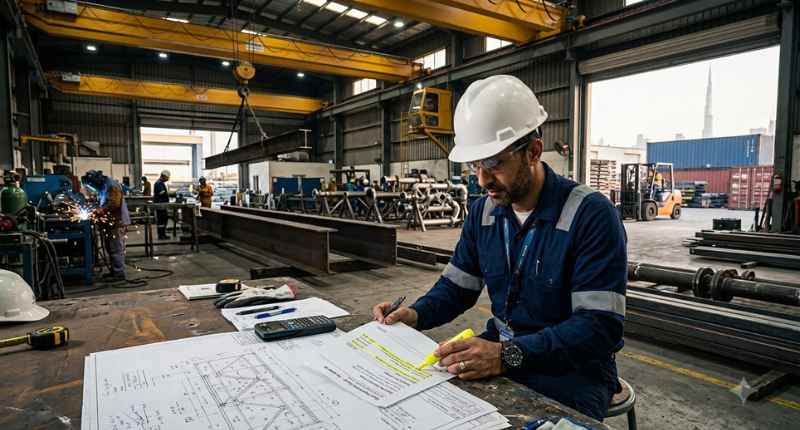
Fabricated steel is heavy, bulky, and often awkward to transport. Delivery costs from a Dubai fabrication yard to a project site are real and variable, and they are frequently excluded from fabrication quotes as a matter of standard practice.
On large structural assemblies or long pipe spools, transport requires low-loaders, wide load permits, and sometimes escort vehicles depending on the route and the dimensions of the load. These logistics costs can add 2% to 5% to the total fabrication cost on large jobs. For offshore projects where fabricated components need to be loaded onto a vessel or barge, load-out costs including crane hire, seafastening materials, and marine survey fees add further.
Ask every fabricator whether their quote includes delivery to site, and if so, whether it is based on a specific site location and access arrangement. A quote based on standard truck delivery to a ground-level laydown area will not cover crane-assisted delivery to an elevated installation point.
For oil and gas, marine, and infrastructure clients in the UAE, the documentation package that accompanies fabricated components is a contractual deliverable, not an optional extra. Material test reports, weld maps, inspection records, NDT reports, welder qualification records, and as-built drawings all take time to produce and compile.
Fabricators who are not accustomed to producing formal data packages frequently underestimate this cost in their quotes, and then charge for it as an additional service when the client requests the documentation at handover. On complex coded fabrication projects, documentation preparation can represent 3% to 5% of the total fabrication cost.
Include documentation requirements in the enquiry specification in the same level of detail as the fabrication requirements. List every document required, the format it must be delivered in, and the review and approval process it must go through before handover. This removes the ambiguity that generates additional charges.
Post-weld heat treatment is required on certain material grades and wall thicknesses under ASME and other pressure equipment codes. It is also one of the cost items most frequently omitted from preliminary fabrication budgets because it depends on the detailed design and material selection, which are often not finalised when the first budget estimate is requested.
The cost of post-weld heat treatment on a pressure vessel or piping system depends on the size of the components, the heat treatment cycle required, and whether it is carried out in a furnace or using localised heating equipment on site. Hydrostatic and pneumatic testing after heat treatment adds further cost. Neither item is small on large pressure equipment: combined, they can add 8% to 15% to the fabrication cost of a coded pressure vessel.
Fabrication yards in Dubai charge for storage when completed fabrication is not collected within the agreed delivery window. On projects where site readiness is delayed, or logistics are complex, completed fabricated components can sit in a yard for weeks while storage charges accumulate.
Standard storage rates in Dubai fabrication yards run from AED 15 to AED 40 per square metre per week depending on the yard and the nature of the stored items. On a large structural package occupying 200 square metres of laydown area for six weeks, that is AED 18,000 to AED 48,000 in storage costs that were not in anyone’s project budget.
Agree on a delivery schedule with the fabricator that matches site readiness, build a storage allowance into the project budget as a contingency, and confirm the fabricator’s storage rates in writing before award.
The hidden costs in metal fabrication projects are not random. They follow predictable patterns across material escalation, cutting waste, rework timing, inspection scope, surface treatment gaps, logistics, documentation, post-weld treatment, and storage.
Each one is avoidable with the right specification, the right contract terms, and the right questions asked before the order is placed.
Hidden costs become easier to spot when you understand standard pricing structures. Read our 2026 Metal Fabrication Cost Guide for Dubai for realistic budget ranges across structural steel, CNC machining, pipe fabrication, and pressure vessel projects.
Contact Brightsun Industries to discuss your fabrication requirement and get a quote that reflects the full scope of your project.
Q1: What are the most common hidden costs in metal fabrication projects in Dubai?
Material price escalation, cutting waste on purchased versus finished weight, late-stage rework costs, excluded third-party inspection fees, surface treatment scope gaps, and storage charges.
Q2: How can UAE buyers avoid extra fabrication charges from surface treatment scope gaps?
Specify the full coating system by standard before the enquiry goes out, including surface preparation standard, primer type and dry film thickness, intermediate and topcoat specifications, and field touch-up requirements, leaving no room for interpretation.
Q3: Why does rework timing matter for the total cost of a fabrication project?
Because the completed work around the defect must also be redone, making in-process inspection the most cost-effective quality control approach.
Q4: Are third-party inspection costs always excluded from fabrication quotes in Dubai?
Not always, but they are frequently excluded when the client has not specified an inspection requirement in the enquiry.
Q5: How do transport and delivery costs affect the total cost of fabrication projects in the UAE?
Delivery to site, including logistics for oversized loads, crane-assisted placement, offshore load-out, and seafastening, can add 2% to 5% to total fabrication cost and should be specified and priced explicitly rather than assumed to be included in the fabrication quote.
Q6: What documentation costs should UAE buyers budget for on coded fabrication projects?
Material test reports, weld maps, NDT records, welder qualifications, inspection records, and as-built drawings can add 3% to 5% to the total fabrication cost
Q7: How does post-weld heat treatment add to metal fabrication project costs?
Post-weld heat treatment combined with subsequent hydrostatic or pneumatic testing can add 8% to 15% to the fabrication cost of coded pressure vessels.
Q8: What storage charges should UAE buyers expect from Dubai fabrication yards?
Standard storage rates in Dubai fabrication yards run from AED 15 to AED 40 per square metre per week.
Q9: How can procurement teams avoid material price escalation on fabrication projects in Dubai?
Confirm in writing whether the quote is fixed price or subject to material escalation, place the order within the quote validity period, and where project timelines require a longer window, negotiate a fixed material price or a defined escalation cap before award.
Q10: Why do UAE buyers need to specify cutting waste assumptions upfront?
A quote based on finished weight rather than purchased weight understates the true material cost by 10% to 25% depending on part geometry.
At a Glance
Related Blogs

Shed No. 10, Fresh Express Warehouse,
Road B1, Dubai Investments Park 1,
Dubai, UAE.
+971 43807099
+971 563244963
+971 503226480