- +971 43807099
- +971 563244963
- brisunco@emirates.net.ae

- Meet Us
Shed No. 10,
Fresh Express Warehouse, Road B1, DIP 1,
Dubai, UAE.
Shed No. 10,
Fresh Express Warehouse, Road B1, DIP 1,
Dubai, UAE.
New
New
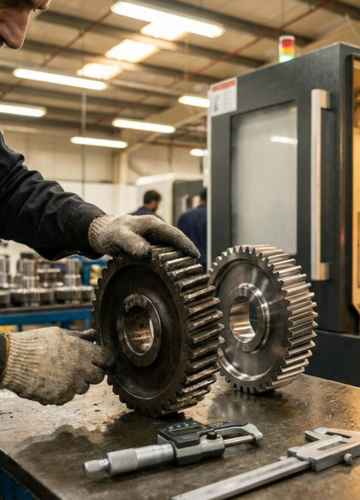
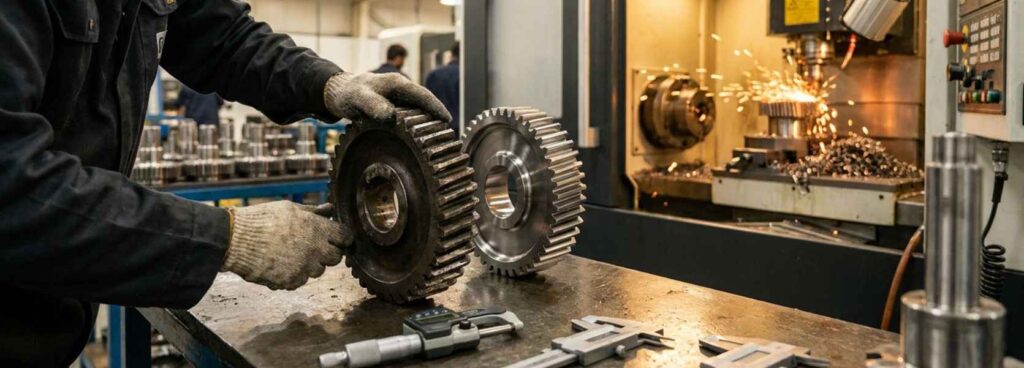
A worn or broken gear on a critical machine is a specific kind of problem. It is not a bolt you can order online or a gasket you can cut from sheet stock. Gears are precision components. The tooth profile, pitch, pressure angle, helix angle, and material grade all have to be exactly right. Get any one of them wrong, and the replacement gear destroys itself and the mating gear within days.
For plant managers and maintenance engineers across Dubai running equipment that is five, ten, or twenty years old, the added difficulty is availability. Original equipment manufacturers discontinue parts. Suppliers go out of business. Regional distributors stop stocking slow-moving items. The gear you need simply does not exist in the supply chain anymore.
This is where emergency gear manufacturing in Dubai becomes the difference between a five-day turnaround and a five-week shutdown.
At a Glance
Most facilities underestimate the cost of a gear failure until they are sitting in one.
The direct cost is lost production. A single worn output gear on a mixer, a crusher, a conveyor drive, or a packaging line can stop an entire process. At AED 50,000 to AED 200,000 per day of lost output for a mid-sized production facility, five days of downtime while a replacement is sourced from overseas is not a supply chain inconvenience. It is a financial event.
The indirect costs compound it. Idle labour. Delayed customer orders. Emergency freight charges on imported parts that may still take two weeks to arrive. And the risk that the imported part, when it finally arrives, is the wrong specification.
Reverse engineering and manufacturing a replacement gear locally removes most of these variables.
Reverse engineering is often part of a broader emergency repair response involving machining, fabrication, and welding. Learn how our 24/7 Emergency Fabrication Services in Dubai: Breakdowns Fixed in 24–72 Hours help industries recover from unexpected equipment failures.
Production downtime caused by worn gears can be just as costly as conveyor failures. See how our team restored a manufacturing line in Factory Conveyor Breakdown Repair: How We Prevented $50K Daily Loss in 36 Hours.
Identifying worn gears before they fail completely is even more cost-effective. Our guide Preventive vs Emergency Fabrication: Cost Analysis for Dubai Factories explains how planned maintenance helps avoid expensive emergency manufacturing and production downtime.
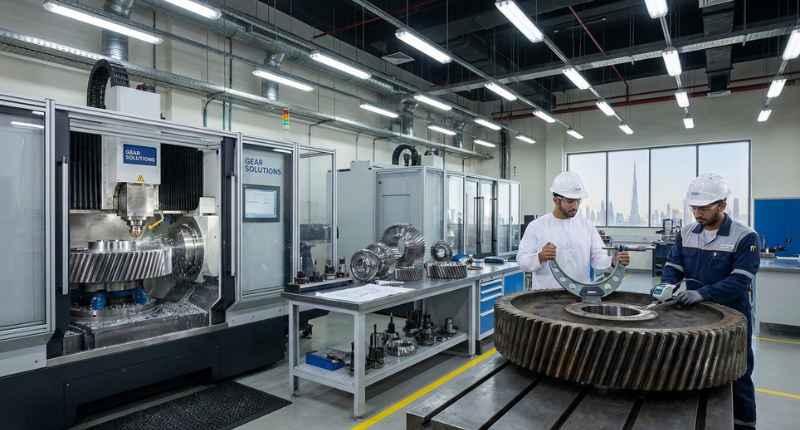
Reverse engineering sounds complex. The process is methodical.
The worn or damaged gear comes into the workshop. Even a gear that has lost teeth or worn significantly past its service limit contains enough geometric information to define the replacement. The team measures the outside diameter, root diameter, face width, number of teeth, and bore dimensions. The tooth profile is checked with gear measurement tools to establish the module and pressure angle. The helix angle is measured on helical gears. The keyway and any mounting features are dimensioned fully.
From these measurements, a complete gear specification is produced. This is the document that drives the CNC machining program and the material selection. It also becomes the quality reference against which the finished gear is inspected before it leaves the workshop.
Material selection follows the specification. Most industrial gears run in medium carbon steel or alloy steel grades that combine machinability with the surface hardness needed for tooth wear resistance. Where the original gear was case hardened or through hardened, the replacement must match that heat treatment to perform correctly against the mating gear. Fitting a softer replacement gear against a hardened mating gear accelerates wear on the new part and shortens its service life.
Five days from the arrival of worn gear to finished replacement is achievable with the right setup. Here is what that timeline looks like in practice.
The gear arrives. Full-dimensional measurement is completed. The gear specification document is produced and reviewed. Material is confirmed and pulled from stock or ordered for next-day delivery. Any ambiguities in the measurement, particularly on heavily worn tooth profiles, are resolved through calculation using the confirmed module and tooth count.
The material blank is cut to length and roughly turned to approximate dimensions on the CNC lathe. The bore is roughed out. The gear blank is left with stock on all surfaces for finish machining after any heat treatment, if required.
Where the specification calls for through hardening or case hardening, the blank goes to heat treatment on day three. This stage cannot be rushed. Incorrect heat treatment produces a gear that either wears rapidly from insufficient hardness or becomes brittle and chips under load from excessive hardness.
The hardened blank returns to the CNC for finish machining of the bore, keyway, and face. Gear cutting follows on the hobbing or gear shaping machine. The tooth profile is generated for the confirmed module and pressure angle. On helical gears, the helix angle is set precisely on the cutting machine. Face width is finished to tolerance. Surface finish on the tooth flanks is verified.
The finished gear is inspected against the specification document. Tooth profile, pitch accuracy, bore diameter, face runout, and surface finish are all checked and recorded. The gear is cleaned, protected for transport, and dispatched or collected for installation.
Gears are only one part of a drivetrain. If a breakdown has also damaged the drive shaft, read Broken Shaft Replacement: Same-Day CNC Machining & Installation in Dubai to learn how emergency CNC machining restores critical rotating components.
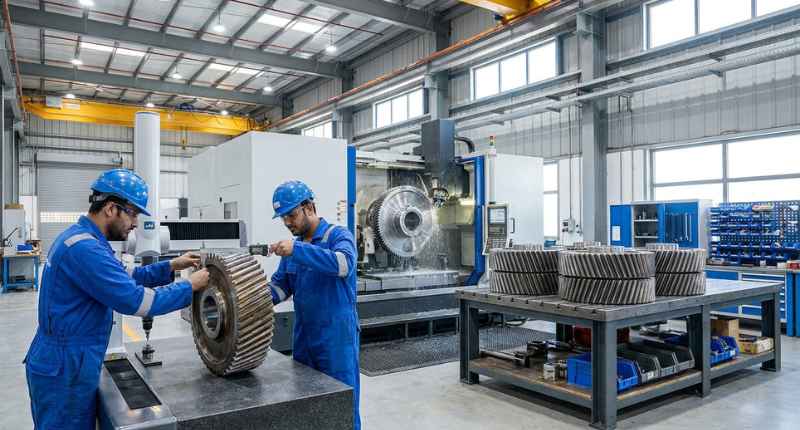
The most common scenario that brings facilities to an emergency gear manufacturing Dubai provider is not a sudden catastrophic failure. It is a gear that has been wearing slowly for months, showing increased noise and vibration, that finally reaches the point where it must be replaced, and the OEM part is no longer available.
This situation is more manageable than it appears. An obsolete gear is still a gear. Its geometry is defined by standards that have not changed. A workshop with the right measurement capability, the right cutting equipment, and the right material knowledge can produce a replacement that performs to the original specification regardless of when the original was made or who made it.
What matters is accurate measurement of the worn original and correct material and heat treatment selection for the replacement. These two elements, done correctly, produce a gear that the original equipment cannot distinguish from the factory part.
Industrial repair expertise extends beyond precision gear manufacturing. Discover how our team contained a critical storage tank failure in Cracked Tank Welding Repair: Preventing Environmental Disaster in 24 Hours, helping prevent environmental damage and costly downtime.
Industrial facilities also depend on rapid response for pipeline failures. Discover how our team restores critical piping systems in Industrial Piping Emergency Repair: Leak Detection to Fixed in 48 Hours.
A worn or obsolete gear does not have to mean weeks of downtime and overseas freight costs. Emergency gear manufacturing Dubai capability exists in the UAE to take a worn component, reverse engineer it accurately, and deliver a correctly specified replacement within five working days.
The facilities that recover fastest from gear failures are the ones that bring the worn part in early, provide clear access information about the equipment it came from, and work with a machining team that treats measurement and material specification as the foundation of the job rather than a formality before cutting begins.
Brightsun Industries provides emergency gear manufacturing in Dubai and custom gear fabrication in the UAE for industrial facilities running equipment with worn, broken, or obsolete gears.
If your production depends on a gear that is no longer available through standard supply channels, contact us to discuss reverse engineering and urgent gear repair options.
Q1: How does emergency gear manufacturing in Dubai handle gears with no original drawings?
The worn gear itself provides enough geometric information for a full specification to be reverse-engineered through dimensional measurement and tooth profile analysis.
Q2: Can a gear with missing or broken teeth still be used as a reference for reverse engineering?
Yes, the remaining teeth and the gear body carry enough dimensional data to establish the module, pressure angle, and all other parameters needed to define the replacement.
Q3: What is the minimum information needed to start a replacement gear machining job?
The worn gear itself is sufficient in most cases, but knowing the equipment make, model, and the gear’s position in the drive train helps resolve any ambiguities in the measurement data.
Q4: How long does urgent gear repair take for a standard spur or helical gear?
Most standard spur and helical gears can be reverse-engineered and manufactured within three to five working days, depending on whether heat treatment is required and material availability.
Q5: Can custom gear fabrication UAE workshops match the hardness of the original gear?
Yes, through hardening and case hardening processes can be matched to the original specification using hardness testing on the worn gear as the reference.
Q6: What happens if the mating gear is also worn?
Running a new gear against a heavily worn mating gear accelerates wear on the new part, so it is worth assessing the mating gear condition at the same time and replacing both if necessary.
Q7: Is obsolete gear manufacturing more expensive than ordering an OEM replacement?
In most cases, locally manufactured replacements are comparable in cost to OEM parts when freight, lead time, and downtime costs are included in the comparison.
Q8: What gear types can be reverse-engineered and manufactured in the UAE?
Spur, helical, bevel, worm, internal gears, rack and pinion sets, and sprockets can all be manufactured through reverse engineering in a correctly equipped UAE machine shop.
Q9: How accurate is a reverse-engineered gear compared to the original?
A correctly reverse-engineered and machined gear meets the same dimensional tolerances as the original, and in some cases, improved material or heat treatment selection produces a longer service life.
Q10: What should a facility do to prepare before calling an emergency gear manufacturing provider?
Remove the worn gear, keep both halves if it has fractured, note the equipment type and the gear’s location in the drive system, and have the gear ready to bring to the workshop or available for collection.
At a Glance
Related Blogs

Shed No. 10, Fresh Express Warehouse,
Road B1, Dubai Investments Park 1,
Dubai, UAE.
+971 43807099
+971 563244963
+971 503226480