- +971 43807099
- +971 563244963
- brisunco@emirates.net.ae

- Meet Us
Shed No. 10,
Fresh Express Warehouse, Road B1, DIP 1,
Dubai, UAE.
Shed No. 10,
Fresh Express Warehouse, Road B1, DIP 1,
Dubai, UAE.
New
New
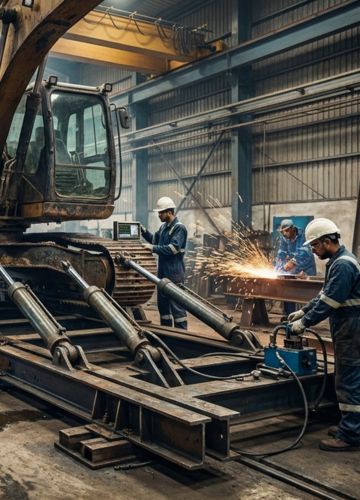
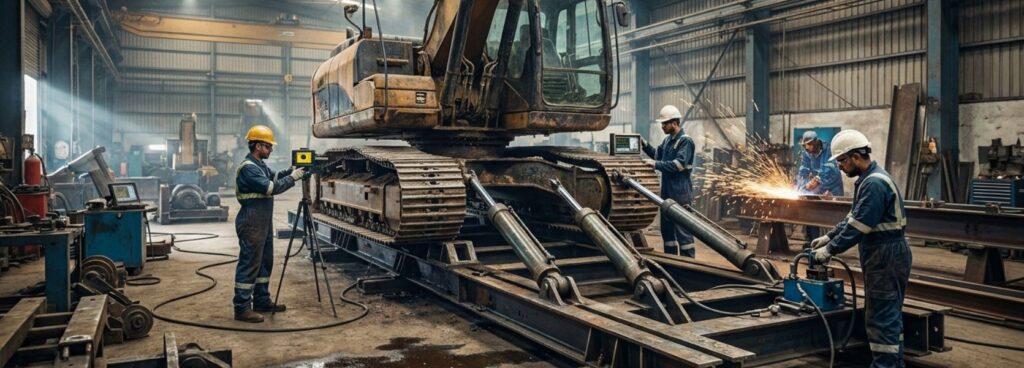
A bent frame stops everything. For construction firms, fleet operators, and industrial facilities across Dubai, heavy equipment sitting out of operation is money leaving the business every hour. Frame straightening Dubai teams deal with this daily, across excavators, trucks, cranes, and forklifts that have taken impact damage, overload stress, or fatigue cracking at the worst possible time.
This is what the repair process looks like, what qualifies as repairable, and how 72 hours from assessment to operation is achievable when the work is done right.
At a Glance
Frames bend for a few common reasons. Impact from another machine or structure. Overloading beyond rated capacity. Ground collapse under a loaded vehicle. Fatigue cracking at a high-stress joint that finally gives way.
Each cause leaves a different signature. An impact bend is localised. Overload damage spreads across a wider section. Fatigue cracks appear at welds, brackets, and corners where stress builds over time.
Identifying the cause matters. Straightening the frame without understanding what caused the bend means the same failure returns. A good repair addresses both.
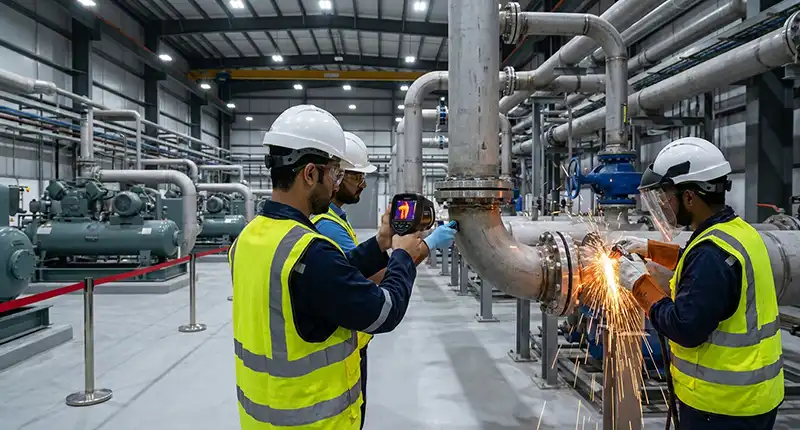
Steel has memory. Bend it, and it wants to spring back. Push too far correcting a bend, and the metal work-hardens in the wrong direction. Get the heat wrong, and the steel loses the mechanical properties that made it a structural grade material.
Frame straightening Dubai work requires hydraulic equipment capable of applying controlled, measurable force at the right point. It requires heat application within precise temperature ranges. And it requires measurement at every stage, not just at the end.
A frame that looks straight is not the same as a frame that measures straight. The difference shows up in tyre wear, driveline vibration, and component failures that seem unrelated to the original damage.
The same focus on precision alignment is essential during production equipment repairs. See how our team restored a manufacturing line in Factory Conveyor Breakdown Repair: How We Prevented $50K Daily Loss in 36 Hours.
Speed in frame repair comes from a clear process, not from cutting steps.
The equipment arrives, or the team mobilises to the site. A full structural inspection maps every point of damage, not just the visible bend. Cracks are checked with magnetic particle or dye penetrant inspection. Measurements are taken across the full frame to establish the true extent of distortion.
This stage determines the repair sequence. Fix the wrong section first, and you can lock distortion into the frame that becomes impossible to remove later.
Hydraulic straightening begins at the primary distortion points. Force is applied in stages with measurement checks between each stage. Where the frame has cracked, the damaged section is cut out. A replacement section is fabricated to match the original profile and welded in with full penetration welds.
Weld quality here is not optional. These joints carry the same structural load as the original frame. NDT inspection follows before the repair moves forward.
Where brackets, mounting points, or gussets have been damaged, these are replaced as part of the repair scope. Correct geometry at every mounting point is what allows components to reinstall without shimming or modification.
The frame is measured against the manufacturer’s specification or, where unavailable, against the undamaged sections. Alignment is checked at axle mounts, cab mounts, engine and gearbox mounts, and attachment points.
Surface preparation and primer coating follow. A repaired frame left uncoated will begin corroding at the weld heat-affected zones within weeks.
Components go back on in sequence. Each system is checked during reassembly rather than after. This catches fitment issues before they become disassembly jobs.
A final operational check confirms the equipment is running within normal parameters before it returns to work.
In many impact-related failures, damaged frames are accompanied by broken drive shafts or rotating components. Read Broken Shaft Replacement: Same-Day CNC Machining & Installation in Dubai to see how emergency CNC machining helps restore critical equipment quickly.
If damaged drivetrain components such as gears are discovered during reassembly, our guide Gear Manufacturing Dubai: When the Part No Longer Exists explains how reverse-engineered replacement gears help return heavy equipment to service without long OEM lead times.
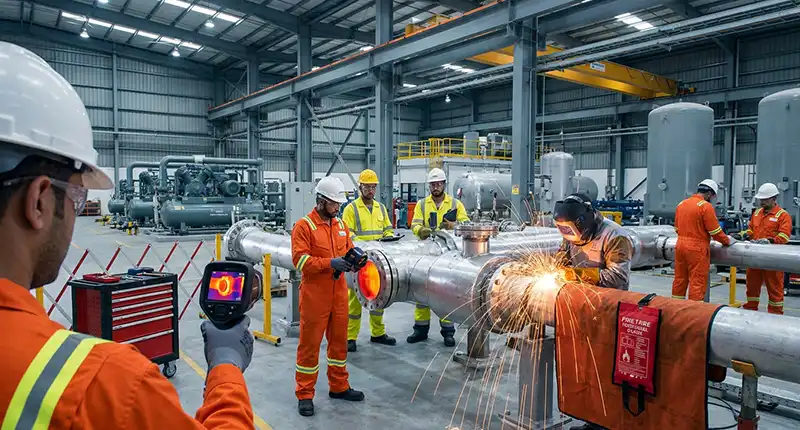
Most frames are repairable. The exceptions are frames where the primary structural section is so severely compromised that the base material can no longer carry the design load even after repair. This is rare.
The deciding factors are the extent of distortion, the condition of the base material away from the damage, and whether the frame geometry can be restored within the manufacturer’s tolerances. An honest assessment from an experienced structural repair services team gives a clear answer within the first few hours of inspection.
Replacing a heavy equipment frame is a high cost. Equipment frame repair in the UAE, done correctly, returns the machine to service at a fraction of that cost and in far less time than sourcing a replacement frame.
Each equipment type has characteristic failure locations. Knowing them speeds up inspection and defines the repair scope accurately from the start.
A bent frame is not a write-off. In most cases, it is a structural repair job with a defined process, a measurable outcome, and a faster return to operation than sourcing a replacement.
Fleet operators and facility managers who handle frame damage well are the ones who call early, get an accurate assessment, and work with a repair team that treats measurement and weld quality as non-negotiable at every stage.
Seventy-two hours from arrival to operation is achievable. It requires the right process applied without shortcuts.
Many structural failures also require emergency welding, machining, and custom metal fabrication alongside frame repairs. Learn how our 24/7 Emergency Fabrication Services in Dubai: Breakdowns Fixed in 24–72 Hours help industrial businesses recover from unexpected breakdowns.
Structural repairs are only one part of keeping industrial operations running. For emergency pipeline failures, read Industrial Piping Emergency Repair: Leak Detection to Fixed in 48 Hours.
The same welding expertise is equally important when repairing damaged industrial storage tanks. Discover how our team contained a critical leak in Cracked Tank Welding Repair: Preventing Environmental Disaster in 24 Hours.
Even better than rapid repairs is preventing structural failures before they happen. Read Preventive vs Emergency Fabrication: Cost Analysis for Dubai Factories to see how scheduled fabrication helps reduce emergency repair costs.
Brightsun Industries provides frame straightening in Dubai and equipment frame repair in the UAE for heavy equipment across construction, logistics, and industrial sectors.
Contact us when you need structural repair services that return your equipment to full operation fast and correctly.
Q1: Can a bent excavator frame be repaired, or does it need to be replaced?
Most bent excavator frames can be repaired through hydraulic straightening and structural welding, provided the base material is sound and geometry can be restored to the manufacturer’s tolerance.
Q2: How do I know if my equipment frame is bent and not just misaligned?
Doors and panels that no longer fit, uneven tyre wear, driveline vibration, and visible kinks or cracks in the frame rails are signs of frame distortion rather than simple component misalignment.
Q3: Is frame straightening in Dubai work covered by equipment insurance?
Most equipment insurance policies cover structural repair from accidental impact or ground collapse, but check whether your policy requires repairs to be carried out by a certified structural repair provider.
Q4: How long does heavy equipment frame repair take?
For most single-point bends without extensive cracking, frame straightening and structural repair are completed within 48 to 72 hours, depending on the extent and whether fabrication of replacement sections is needed.
Q5: Can a cracked frame be welded and returned to full structural capacity?
Yes, provided the crack is fully removed, the replacement section is fabricated from the correct material grade, and full penetration welds are inspected by NDT before sign-off.
Q6: What causes heavy equipment frames to crack at welds?
Weld cracks on heavy equipment frames are almost always fatigue-related, caused by cyclic loading over time at stress concentrations where brackets, gussets, or crossmembers meet the main frame rail.
Q7: Does frame repair affect the resale value of heavy equipment?
A professionally repaired frame with documented inspection records and NDT certification has less impact on resale value than unrepaired damage and, in many cases, restores the equipment to insurable condition.
Q8: Can frame straightening be done on-site, or does the equipment need to come to a workshop?
Minor straightening and crack repair can be carried out on-site for equipment that cannot be transported, but workshop-based repair gives better access, more controlled conditions, and more accurate measurement.
Q9: What is the difference between bent frame fabrication and frame straightening?
Frame straightening corrects distortion in the existing frame using hydraulic force and controlled heat, while bent frame fabrication involves cutting out a damaged section and welding in a newly fabricated replacement.
Q10: How do repair teams verify the frame is straight after repair?
Verification involves physical measurement at all major mounting points against the manufacturer’s dimensional specification, combined with NDT inspection of all welds completed during the repair.
At a Glance
Related Blogs

Shed No. 10, Fresh Express Warehouse,
Road B1, Dubai Investments Park 1,
Dubai, UAE.
+971 43807099
+971 563244963
+971 503226480