- +971 43807099
- +971 563244963
- brisunco@emirates.net.ae

- Meet Us
Shed No. 10,
Fresh Express Warehouse, Road B1, DIP 1,
Dubai, UAE.
Shed No. 10,
Fresh Express Warehouse, Road B1, DIP 1,
Dubai, UAE.
New
New
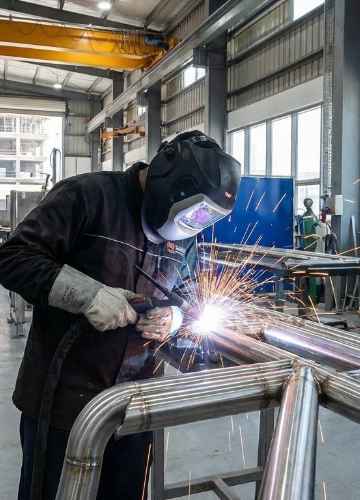
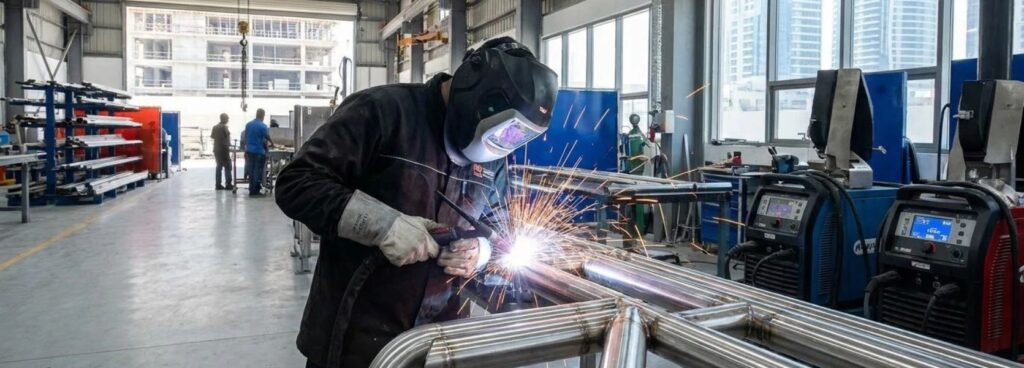
Dubai’s industrial base runs on stainless steel. Food processing lines, pharmaceutical facilities, oil and gas equipment, and marine installations. All of it specifies stainless for the same reason: it holds up where carbon steel fails. But stainless steel does not forgive poor welding. Get the heat input wrong, and you sensitise the material. Contaminate the weld zone, and you have introduced corrosion initiation points that will show up months later, not during inspection.
This is not about finding a welder who can run a bead on stainless. It is about finding an SS welding company in the UAE that has built its operation around the specific demands of the material. This guide covers what those demands are, where most shops fall short, and what to verify before you award stainless welding work in Dubai in 2026.
At a Glance
Stainless steel is not a single material. It is a family of alloys. The three grades most common in UAE industrial work are austenitic, duplex, and martensitic, and each one behaves differently under welding conditions.
Austenitic grades, the 300 series including 304 and 316, are the most widely used. They have low thermal conductivity and high thermal expansion. Heat builds up fast. Distortion follows. Controlling heat input and interpass temperature is not optional. It is what keeps the material performing the way it was specified to perform.
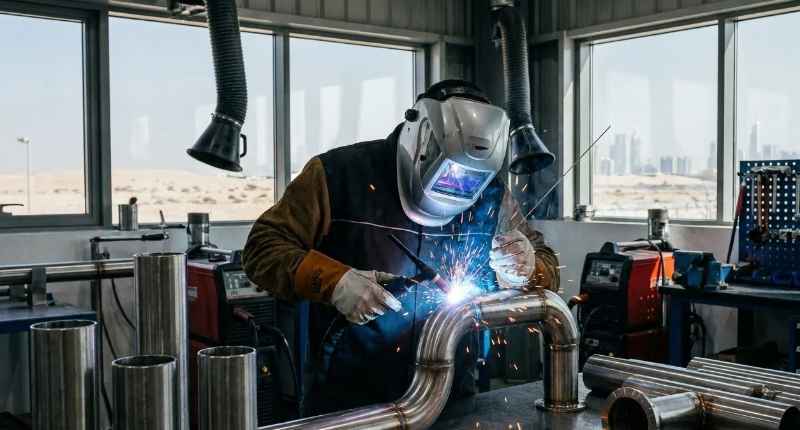
Sensitisation happens when stainless steel sits in the 450 to 850 degree Celsius range for too long during welding. Chromium carbides form at grain boundaries. The chromium that should be forming the protective oxide layer is no longer available to do that job.
The result is a weld that passes visual inspection and fails six months into service. Low-carbon grades designated with the L suffix, 304L and 316L, reduce this risk. But they do not eliminate it. Heat input control during welding is still the primary defence.
Duplex stainless steels are common in UAE oil and gas pipework, pressure vessels, and marine applications. They offer higher strength than the 300 series and good corrosion resistance. They are also more sensitive to heat input than austenitic grades.
Too much heat shifts the phase balance toward ferrite and reduces toughness. Too little promotes sigma phase formation, which embrittles the material. The window is narrow. Welding duplex correctly requires tighter process control than most general fabrication shops apply, and most general fabrication shops will not tell you that.
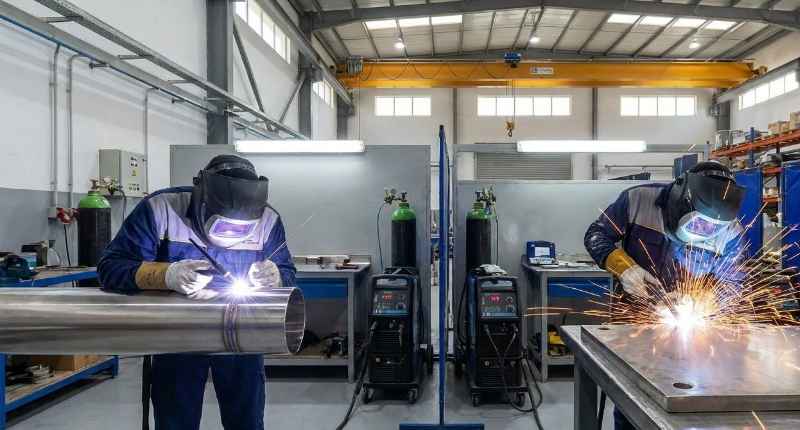
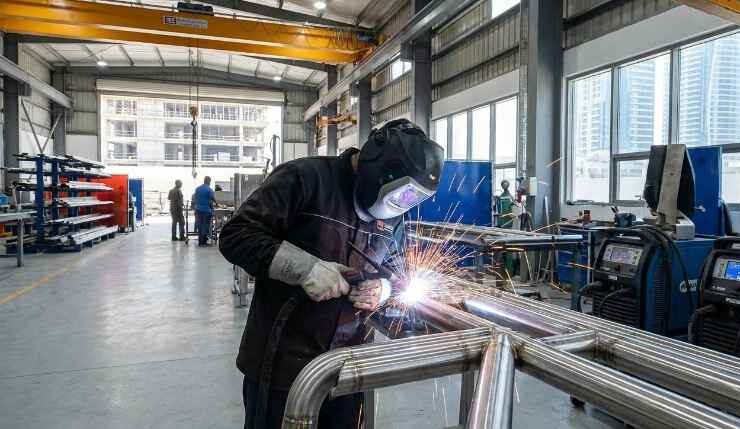
TIG welding is the preferred process for precision stainless work. A non-consumable tungsten electrode and separately fed filler wire give the welder independent control over arc and filler addition. That control makes TIG the right choice for thin material, pipe root passes, and any application where weld quality is a compliance requirement.
MIG welding is faster and suits thicker sections where productivity matters more than a refined bead profile. The shielding gas for stainless MIG is a tri-mix or bi-mix of argon and carbon dioxide, with carbon dioxide content kept low to minimise carbon pickup in the weld. For high-volume stainless fabrication where TIG speed becomes a constraint, MIG with the right gas mix and qualified procedure is a legitimate option.
Understanding the advantages and limitations of each process is essential when selecting the right technique, as explained in our guide to TIG vs MIG welding for stainless steel.
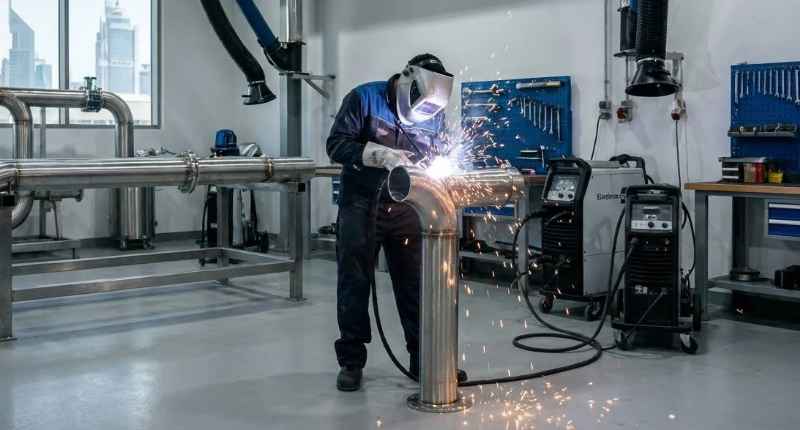
TIG welding stainless pipe requires argon back purging on the root side. Without it, the inside of the weld oxidises during welding. The discolouration that results, commonly called sugaring, indicates loss of corrosion resistance at the root.
A weld root that has sugared will be rejected on any properly inspected job. It should be. The inside surface of a stainless pipe weld is often in direct contact with the process fluid. Corrosion at the root is corrosion where it matters most. When evaluating stainless steel welding services Dubai providers, ask to see a cut section from a recent pipe weld. The root tells you everything.
Filler selection for stainless is not simply matching the wire grade to the base material. The filler must account for dilution from the base material, the service conditions the weld will see, and the need to maintain a small ferrite content in austenitic weld deposits to resist hot cracking.
For 304 base material, ER308L is standard. For 316, ER316L maintains the molybdenum content that gives 316 its pitting resistance. For duplex grades, the filler is typically over-alloyed to compensate for nitrogen loss during welding. Mixing stainless fillers with carbon steel consumables is not a quality error. It is a guarantee of corrosion failure in service.
Carbon steel contamination is one of the most common causes of stainless weld failure in workshops that handle both materials. Iron particles from carbon steel grinding deposit on the stainless surface. Rust spots initiate and propagate under the passive oxide layer. The fabrication looks fine at handover and fails in service.
A shop that grinds carbon steel on the same bench where stainless components are prepared, or uses the same angle grinder wheels on both materials, is creating a contamination risk that the most skilled welder cannot fix. Dedicated stainless work areas, segregated tooling, and stainless-specific wire brushes and grinding discs are baseline requirements. Not premium features.
Pickling removes heat tint from the weld zone and surrounding heat-affected area using an acid solution, typically nitric and hydrofluoric acid. It also removes iron contamination introduced during fabrication. On any stainless weld exposed to a corrosive environment in service, pickling is mandatory.
Passivation follows pickling and promotes the formation of the chromium oxide passive layer using nitric or citric acid. For food-grade and pharmaceutical work, it is a compliance requirement. Electropolishing goes further, removing a thin layer of material electrolytically to produce a smooth, low-roughness surface that resists bacterial adhesion and corrosion initiation. Not every stainless steel welding services Dubai provider offers these treatments in-house. Shops that subcontract post-weld treatment introduce handling risk and scheduling delays that compliance-driven projects cannot absorb.
ASME Section IX governs welder and welding procedure qualification on pressure equipment. Any stainless steel welder on pressure vessels or piping under ASME jurisdiction must hold a current Section IX qualification for the relevant base material group, process, and position. AWS D1.6 covers structural stainless applications outside the pressure equipment codes.
For food-grade and pharmaceutical work, EHEDG guidelines and 3-A sanitary standards define the surface finish, joint geometry, and documentation requirements for food contact and pharmaceutical manufacturing environments. ASME BPE applies specifically to pharmaceutical and biotech process equipment. These are not interchangeable standards. The applicable code depends on the service, and the fabricator needs to know the difference.
Meeting these standards also depends on having welders with the correct qualifications for the project scope. Learn more about stainless steel welding certifications in the UAE and how to verify welder qualification records, material group coverage, and applicable welding standards.
In oil and gas, stainless pipe spools, pressure vessels, heat exchanger components, and chemical injection systems are fabricated to ASME codes with full documentation and third-party inspection. Duplex and super duplex grades dominate offshore and sour service applications. In food processing and catering, stainless tanks, hoppers, conveyors, and food contact surfaces are fabricated to sanitary standards with smooth, crevice-free welds and pickled or polished finishes.
In pharmaceutical manufacturing, ultra-clean piping systems and storage vessels are fabricated to ASME BPE. In marine and offshore construction, stainless handrails, pipe supports, and deck fittings handle saltwater exposure where carbon steel would corrode rapidly. Each application has its own standard, its own surface finish requirement, and its own inspection expectation. A SS welding company in the UAE that serves all of these sectors needs qualified procedures and personnel across all of them.
A workshop visit tells you more than a prequalification questionnaire. Look for physical separation between the stainless and carbon steel work areas. Check that grinding discs, wire brushes, and clamps are segregated by material and labelled. Ask to see the back purging setup for pipework and a cut section from a recent pipe weld root.
Ask for welder qualification records specific to stainless grades and the processes used on your project scope. Request a sample data package from a completed stainless job. It should include weld maps, material test reports, WPS documents, welder qualification records, and inspection records as standard. If any of these are missing or have to be chased, that is the answer to your vendor evaluation question.
Stainless steel welding services in Dubai cover a technically demanding range of work where the failure modes are invisible until they are expensive. Sensitisation, contamination, incorrect filler selection, and inadequate post-weld treatment all pass visual inspection and fail in service.
The SS welding company UAE operations that deliver consistently are the ones that have built their stainless processes on the right foundations from the start. Separated work areas, qualified welders, documented procedures, and in-house post-weld treatment capability. In 2026, the Dubai market has no shortage of shops listing stainless as a capability. The list of shops that can prove it under scrutiny is considerably shorter.
Brightsun Industries provides stainless steel welding services in Dubai and across the UAE for clients in oil and gas, marine, food processing, and industrial fabrication. With ISO 9001:2015 certification, qualified welders, and documented procedures across stainless grades and welding processes, Brightsun Industries delivers stainless fabrication work that meets code requirements and holds up in demanding service environments.
Contact Brightsun Industries to discuss your stainless steel fabrication requirements and quality documentation needs.
Here is our contact form.
Q1: What makes stainless steel welding services in Dubai different from carbon steel welding?
Stainless steel requires tighter heat input control to prevent sensitisation, dedicated tooling and work areas to prevent carbon steel contamination, specific filler materials matched to the base grade, and post-weld treatment to restore corrosion resistance after welding.
Q2: What is sensitisation and why does it matter in stainless steel welding?
Sensitisation occurs when stainless steel is held in the 450 to 850 degree Celsius range too long during welding, causing chromium carbides to form at grain boundaries and reducing corrosion resistance in the heat-affected zone.
Q3: Which welding process is best for stainless steel pipework in the UAE?
TIG welding with argon back purging is the standard process for stainless pipe root passes and precision work, providing the heat control and weld quality required for pressure piping and hygienic applications.
Q4: What is back purging and why is it required for stainless steel pipe welding?
Back purging floods the inside of a pipe with inert gas during welding to prevent oxidation of the weld root, which would otherwise cause discolouration and loss of corrosion resistance at the inside surface of the joint.
Q5: How do I know if an SS welding company in the UAE has genuine stainless capability?
Visit the workshop and check for a dedicated stainless work area physically separated from carbon steel fabrication, segregated tooling, back purging equipment for pipe work, and documented welder qualifications specific to stainless grades and processes.
Q6: What post-weld treatments are required for stainless steel welding in food and pharmaceutical applications?
Food-grade and pharmaceutical stainless welding requires pickling to remove heat tint and iron contamination, followed by passivation to restore the chromium oxide passive layer, with electropolishing specified for the highest hygiene and surface cleanliness requirements.
Q7: What filler material should be used for welding 316L stainless steel?
ER316L filler wire is the standard choice for 316L base material, maintaining the molybdenum content that gives 316L its pitting corrosion resistance in chloride-containing environments.
Q8: Can stainless steel and carbon steel be welded together?
Yes, dissimilar metal welding of stainless to carbon steel is possible using appropriate filler materials such as ER309L, but the joint design, filler selection, and inspection requirements differ from standard stainless-to-stainless welding.
Q9: What standards govern stainless steel welding qualifications in the UAE?
ASME Section IX covers welder and procedure qualification for pressure equipment, AWS D1.6 covers structural stainless welding, and ASME BPE applies to pharmaceutical and high-purity process equipment fabricated from stainless steel.
Q10: Why does duplex stainless steel require more controlled welding than standard 304 or 316 grades?
Duplex stainless steel has a two-phase microstructure that is sensitive to both excessive and insufficient heat input during welding, with too much heat promoting ferrite formation and too little causing sigma phase embrittlement, both of which degrade mechanical and corrosion performance.
At a Glance
Related Blogs

Shed No. 10, Fresh Express Warehouse,
Road B1, Dubai Investments Park 1,
Dubai, UAE.
+971 43807099
+971 563244963
+971 503226480