- +971 43807099
- +971 563244963
- brisunco@emirates.net.ae

- Meet Us
Shed No. 10,
Fresh Express Warehouse, Road B1, DIP 1,
Dubai, UAE.
Shed No. 10,
Fresh Express Warehouse, Road B1, DIP 1,
Dubai, UAE.
New
New
Most people asking this question already know that both processes weld stainless steel. What they need to know is which one produces the right result for their specific application, at the right cost, in the right timeframe.
The answer is not universal. TIG welding produces better results in some applications. MIG welding produces better results in others. Defaulting to TIG because it sounds more precise, or to MIG because it sounds faster, produces the wrong process selection about half the time. This guide breaks down the comparison of stainless steel welding methods that UAE project teams and procurement managers need to make the right call before work begins.
At a Glance
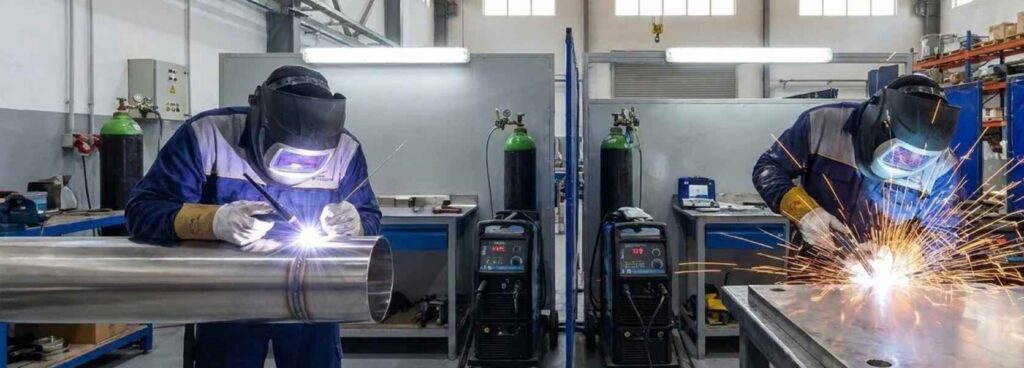
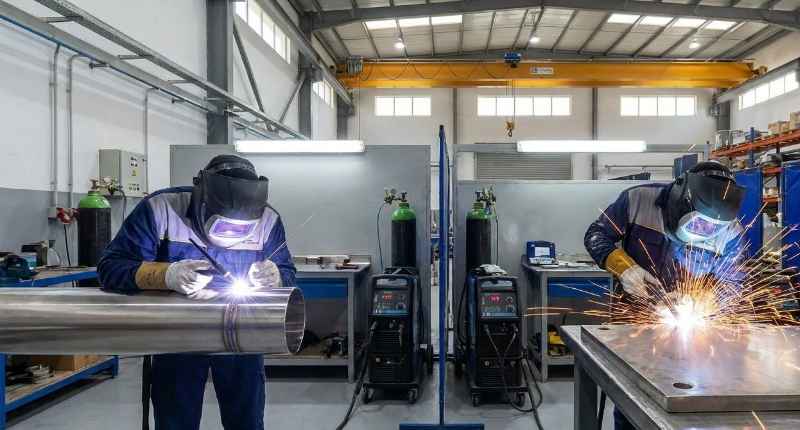
TIG welding uses a non-consumable tungsten electrode to create the arc and a separately fed filler wire to add material to the weld pool. The welder controls the arc and filler addition independently, providing precise control over heat input, weld bead profile, and fusion at the joint root.
For stainless steel, TIG welding uses argon shielding gas on the torch side. On pipe and vessel work where the inside of the weld is exposed to the process fluid, argon back purging is required on the root side to prevent oxidation of the weld root. A back-purged TIG root pass on stainless pipe produces a smooth, oxide-free internal surface that retains the full corrosion resistance of the parent material.
TIG welding is slow. A skilled TIG welder deposits significantly less metal per hour than a MIG welder on the same joint. That speed difference is the central trade-off in the TIG vs MIG welding for stainless steel comparison, and understanding when that trade-off is justified is the core of the decision.
Regardless of the welding process selected, the welder must hold qualifications that cover the specific material, process, and welding position. Read our guide on stainless steel welding certifications in the UAE to understand ASME Section IX, AWS D1.6, and WPQ requirements.
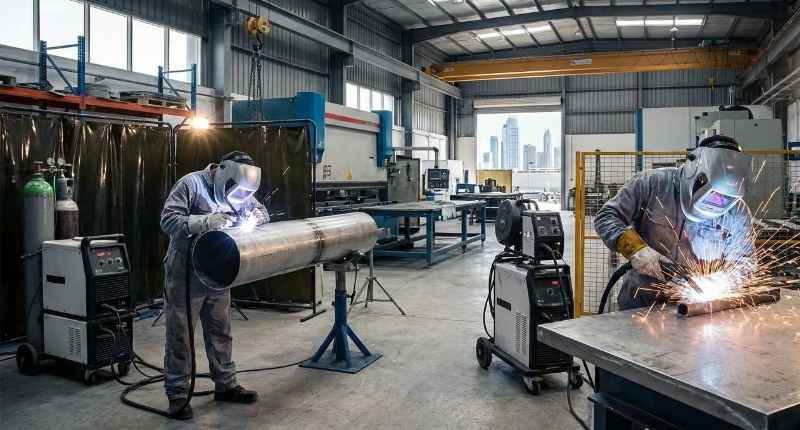
MIG welding uses a continuously fed consumable wire electrode and is significantly faster than TIG. The arc is maintained automatically as the wire feeds into the weld pool, allowing higher travel speeds and higher deposition rates than TIG can achieve.
For stainless steel, MIG welding uses a shielding gas mix rather than pure argon. A tri-mix of argon, helium, and carbon dioxide, or a bi-mix of argon and carbon dioxide, is used with the carbon dioxide content kept low, typically below 2.5%, to minimise carbon pickup in the weld deposit. Carbon pickup in a stainless MIG weld increases sensitisation risk and reduces corrosion resistance in the heat-affected zone.
MIG welding produces more spatter than TIG on stainless steel and leaves a wider heat-affected zone for equivalent plate thickness. On thin material, MIG is harder to control and produces more distortion than TIG. On thicker sections where travel speed and deposition rate matter, MIG’s speed advantage becomes the deciding factor.
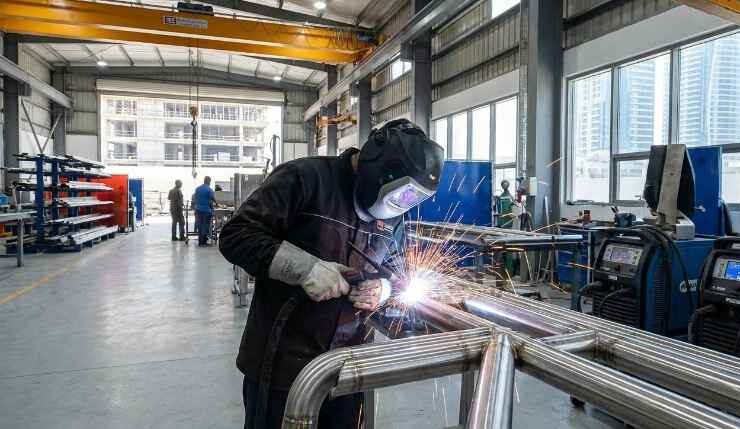
TIG welding is the correct process for stainless steel applications where weld quality, root integrity, and appearance are the primary requirements.
Pipe welding for process, pharmaceutical, and food service applications requires TIG root passes with back purging as a baseline expectation. The inside surface of a stainless pipe weld is in direct contact with the process fluid. A MIG root on stainless pipe is harder to control, more likely to produce oxidation on the inside surface, and less likely to produce the smooth, crevice-free internal geometry that pharmaceutical and food-grade piping standards require.
Thin material below 3mm is a TIG application. MIG on thin stainless sheet produces burn-through, excessive distortion, and weld profiles that require significant post-weld dressing. TIG on the same material, in the hands of a skilled welder, produces controlled, consistent welds with minimal distortion.
Appearance-critical work, including architectural stainless, catering equipment, and visible process piping, is a TIG application. TIG produces a refined bead profile with minimal spatter that requires less post-weld finishing. MIG produces a wider, rougher bead with spatter that must be removed before the surface treatment or polish is applied.
Precision joints with tight dimensional tolerances are TIG applications. The independent control of arc and filler in TIG allows the welder to manage joint fit-up variations that would cause quality problems in MIG welding. On joints with inconsistent root gaps or variable fit-up, TIG is more forgiving and more consistent.
MIG welding is the correct process for stainless steel applications where production speed and deposition rate are the primary requirements and weld appearance is secondary.
Heavy fabrication on plate above 6mm is where MIG’s speed advantage becomes commercially significant. A structural stainless frame, a large storage tank, or a heavy equipment enclosure built from 8mm to 12mm stainless plate is a MIG application. The heat-affected zone and bead profile differences between TIG and MIG on these thicknesses do not affect structural performance, and the productivity difference between the two processes on large structural joints is substantial.
Multi-pass groove welds on thick stainless sections use TIG for the root pass, and MIG for fill and cap passes. This combination captures TIG’s root quality advantage and MIG’s deposition rate advantage on the fill passes that represent most of the weld volume. It is the standard approach on medium to heavy stainless piping and vessel fabrication where both root integrity and production efficiency matter.
High-volume repetitive fabrication where the joint configuration is consistent and the application does not require the refined finish of TIG is a MIG application. Welding fixtures, support brackets, equipment frames, and stainless steelwork for industrial facilities where weld appearance is not a client requirement all suit MIG welding for the same reasons structural carbon steel fabrication uses MIG.
For projects requiring professional execution, qualified welders, and controlled fabrication procedures, explore our stainless steel welding services in Dubai.
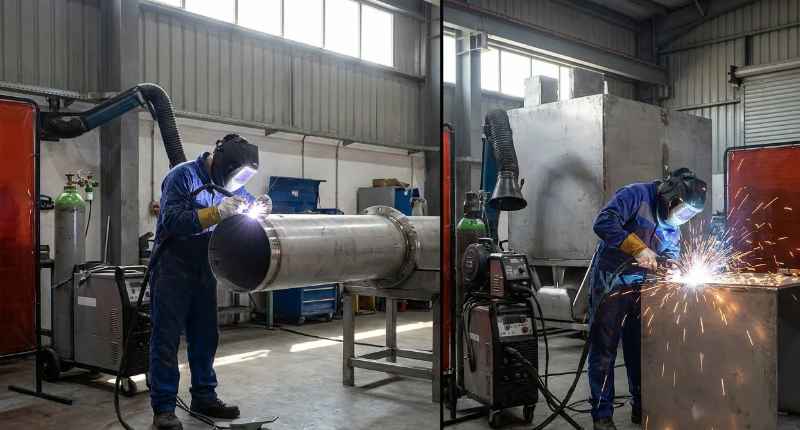
The stainless steel welding method comparison UAE project teams should apply to their specific scope comes down to four questions.
What is the material thickness? Below 3mm, TIG. Above 6mm, MIG or a TIG root with MIG fill. Between 3mm and 6mm, the application requirements determine the process.
What is the joint access and configuration? Pipe root passes and restricted access joints favour TIG. Open flat or horizontal groove welds on thick plate favour MIG.
What are the surface finish and internal cleanliness requirements? Pharmaceutical, food grade, and appearance-critical applications require TIG. General industrial and structural applications where finish is not specified accept MIG.
What is the production volume and schedule? Single units and small batches where quality is the primary driver favour TIG. High-volume production where schedule and cost are the primary drivers favours MIG where the application allows it.
Both TIG and MIG welding introduce heat into stainless steel, and both require heat input management to control distortion and sensitisation. Stainless steel has lower thermal conductivity and higher thermal expansion than carbon steel, which means it distorts more readily under welding heat and retains that heat in the weld zone longer.
Interpass temperature control, limiting the maximum temperature of the weld area between passes, applies to both TIG and MIG on stainless steel. The maximum interpass temperature for most austenitic grades is 150 degrees Celsius. Exceeding it increases sensitisation risk and distortion on both processes.
Welding sequence and fixturing manage distortion on both TIG and MIG stainless work. The process choice does not change the need for a planned weld sequence. It changes the speed at which that sequence is executed and the level of control the welder has at each stage.
TIG vs MIG welding for stainless steel is a process selection decision, not a quality ranking. TIG is not inherently better. MIG is not inherently faster in every application. The right process is the one matched to the material thickness, joint configuration, surface finish requirement, and production volume of the specific scope in front of you.
UAE project teams who make this decision correctly before fabrication begins get better weld quality, more predictable costs, and fewer post-weld corrections than those who default to one process for all stainless work regardless of application.
Contact Brightsun Industries to discuss your stainless steel fabrication requirements and the right welding process for your application.
Q1: What is the main difference in TIG vs MIG welding for stainless steel?
TIG uses a non-consumable tungsten electrode and separately fed filler wire for precise heat and bead control, while MIG uses a continuously fed consumable wire electrode for higher deposition rates and faster travel speeds on thicker sections.
Q2: Which stainless steel welding method do UAE pharmaceutical and food grade projects require?
TIG welding with argon back purging on pipe root passes is the standard requirement for pharmaceutical and food-grade stainless piping, producing smooth, oxide-free internal surfaces that meet hygiene and surface cleanliness standards.
Q3: When is MIG welding acceptable for stainless steel fabrication in the UAE?
MIG welding is acceptable for heavy structural stainless fabrication above 6mm, high-volume repetitive joints where appearance is not specified, and fill and cap passes on thick stainless sections where TIG has been used for the root pass.
Q4: Why is carbon dioxide content in MIG shielding gas important for stainless steel welding?
High carbon dioxide content in the shielding gas increases carbon pickup in the weld deposit, raising sensitisation risk and reducing corrosion resistance in the heat-affected zone, which is why carbon dioxide content is kept below 2.5% for stainless MIG welding.
Q5: What is back purging and when is it required in stainless steel welding?
Back purging floods the inside of a pipe with argon during TIG root welding to prevent oxidation of the weld root, and is required on all stainless pipe welds where the inside surface will be in contact with a process fluid or where internal corrosion resistance must be preserved.
Q6: Can TIG and MIG welding be combined on the same stainless steel joint?
Yes, using TIG for the root pass to ensure internal quality and MIG for fill and cap passes to improve deposition rate is standard practice on medium to heavy stainless piping and vessel fabrication where both root integrity and production efficiency are required.
Q7: What is the maximum interpass temperature for austenitic stainless steel welding?
The maximum interpass temperature for most austenitic stainless grades is 150 degrees Celsius, and exceeding it increases sensitisation risk and distortion on both TIG and MIG welding processes.
Q8: Why does MIG welding produce more distortion than TIG on thin stainless sheet?
MIG is harder to control on thin material and delivers heat input less precisely than TIG, producing wider heat-affected zones and more thermal distortion on sheet below 3mm, where TIG’s independent arc and filler control is better suited to the application.
Q9: How does the stainless steel welding method comparison for UAE structural projects differ from process piping projects?
Structural stainless fabrication on plate above 6mm favours MIG for its speed and deposition rate advantages, while process piping projects require TIG root passes with back purging for internal surface quality and corrosion resistance regardless of wall thickness.
Q10: What post-weld treatment applies to both TIG and MIG stainless steel welds in corrosive service?
Pickling to remove heat tint and iron contamination from the heat-affected zone, followed by passivation to restore the chromium oxide passive layer, applies to both TIG and MIG stainless steel welds exposed to corrosive service environments.
At a Glance
Related Blogs

Shed No. 10, Fresh Express Warehouse,
Road B1, Dubai Investments Park 1,
Dubai, UAE.
+971 43807099
+971 563244963
+971 503226480