- +971 43807099
- +971 563244963
- brisunco@emirates.net.ae

- Meet Us
Shed No. 10,
Fresh Express Warehouse, Road B1, DIP 1,
Dubai, UAE.
Shed No. 10,
Fresh Express Warehouse, Road B1, DIP 1,
Dubai, UAE.
New
New
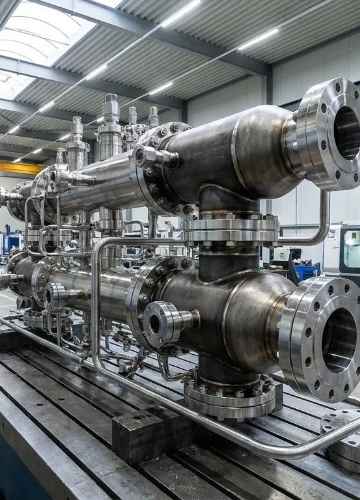
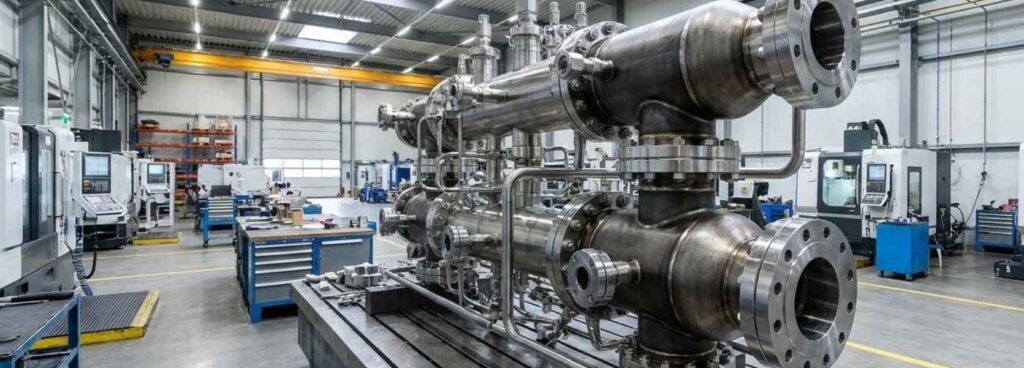
Oil and gas systems do not run on catalogue parts. The pressure ratings, port configurations, material grades, and connection standards that define a manifold for upstream production or downstream processing are specific to the system it sits in. A standard manifold from a distributor’s shelf may share a name with what the application requires. It rarely shares the specification.
For oil and gas operators, EPC contractors, and procurement teams in Dubai, this guide covers what custom manifold manufacturing involves, what standards apply, and what separates a capable manifold fabricator from one that will create problems downstream.
At a Glance
The variables that define an oil and gas manifold are too specific for a standard catalogue range to cover.
Operating pressure spans from a few hundred bar in production headers to over 1,000 bar in high-pressure gas wells. Each pressure class requires a specific body rating, wall thickness, and connection standard. Process fluid defines material selection. A manifold handling dry natural gas has different material requirements from one handling wet sour gas containing hydrogen sulphide, produced water with high chloride content, or aggressive chemical injection fluids. System geometry defines port configuration. The number, size, orientation, and connection standard of every port is defined by the system’s piping and instrument diagram. A manifold with the wrong port layout requires field modification that introduces leak paths and compromises design integrity.
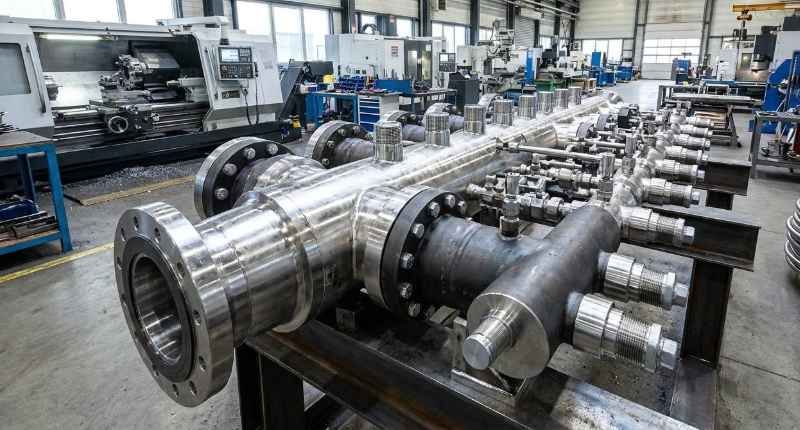
The process starts with a complete design specification covering rated working pressure, design temperature, process fluid and its corrosive constituents, body material and grade, port sizes and connection standards, pressure class to ASME B16.34 or API 6A, testing requirements, and documentation deliverables. An incomplete specification produces a manifold that is correct on the dimensions the fabricator assumed and wrong on the ones left unspecified.
To understand the complete journey from engineering requirements and material selection to fabrication, inspection, and final delivery, explore our industrial manifold manufacturing process guide.
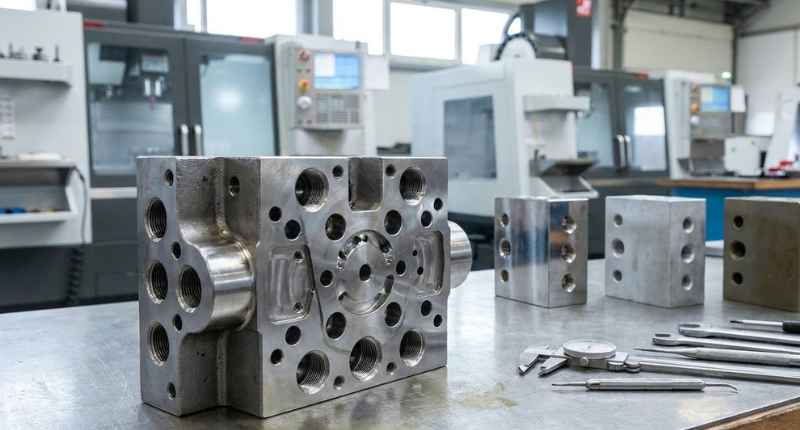
Manifold bodies for oil and gas service are machined from solid bar stock or forged blanks rather than fabricated from welded plate sections. Machined and forged bodies have superior integrity in pressure-containing locations at equivalent ratings. CNC machining of internal passages, port connections, and face features produces the dimensional accuracy required for leak-free assembly of instrument and piping connections.
For more insight into manifold design, internal passage planning, CNC machining, and inspection, read our guide to the hydraulic manifold manufacturing process.
Where welded port attachments are required, welding must follow qualified Welding Procedure Specifications with full penetration joints on pressure-containing connections. For sour service manifolds under NACE MR0175, post-weld heat treatment may be required to meet hardness limits on the weld and heat-affected zone.
Material selection follows the process fluid classification and the applicable material standard.
Carbon steel to ASTM A105 covers standard service manifolds in non-corrosive hydrocarbon service. It is the most cost-effective option where service conditions permit. Stainless steel to ASTM A182 F316L covers corrosive applications including produced water handling and process streams with moderate chloride content. The molybdenum addition in 316L provides pitting resistance that 304L cannot match in chloride service.
Duplex stainless steel to ASTM A182 F51 covers high-chloride and sour service environments where austenitic grades are susceptible to stress corrosion cracking. Super duplex and Inconel grades cover the most aggressive conditions, including high-pressure sour gas and deepwater production equipment. These materials carry significant cost premiums but are the correct specification where lower grades are unreliable.
For a broader comparison of material properties, strengths, and applications, explore our guide to materials used in manifold manufacturing, covering steel, aluminium, stainless steel, and engineering alloys.
Manifold fabrication for oil and gas UAE projects encounters two primary standards depending on whether the manifold is upstream production equipment or process system equipment.
API 6A applies to wellhead and Christmas tree equipment and the manifold assemblies used in upstream production. It defines pressure class ratings from 2,000 psi to 20,000 psi, material classes, temperature classes, and mandatory testing requirements. Body hydrostatic testing, seat testing, and low-pressure gas testing are all required, with test pressures defined as multiples of rated working pressure.
ASME B16.34 applies to manifolds in pipeline and process system service, defining pressure-temperature ratings by material group and pressure class. Shell hydrostatic testing and seat leakage testing are required before release. Manifolds meeting the ASME Section VIII threshold require additional design documentation and witnessed testing by an authorised inspector.
Third-party inspection by Bureau Veritas, Lloyd’s Register, DNV, or an equivalent body is standard on both API 6A and ASME coded manifold work in the UAE. Inspection records form part of the handover documentation package.
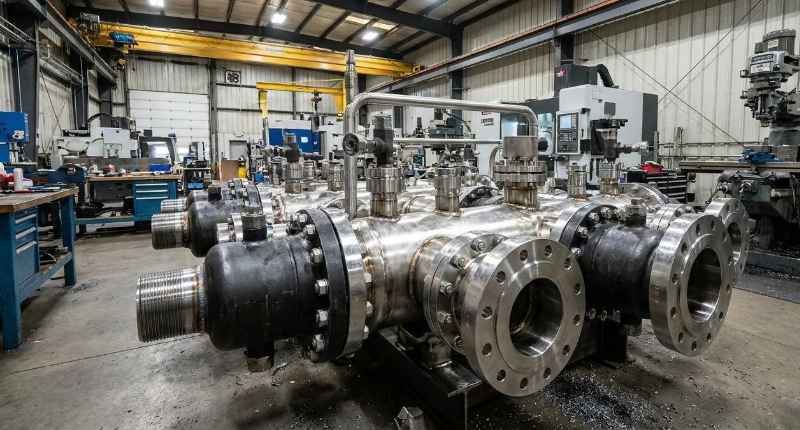
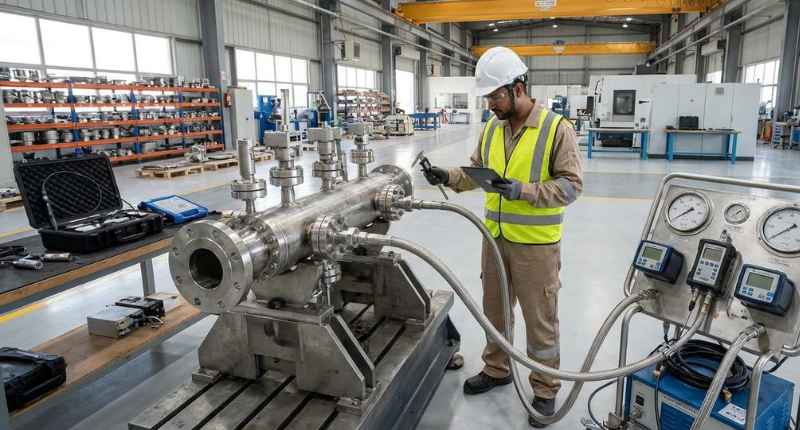
Hydrostatic shell testing at 1.5 times the rated working pressure confirms the integrity of the manifold body and all pressure-containing connections. The test holds for the duration specified by the applicable standard, with results recorded and witnessed. Seat leakage testing confirms integral valve seat and check valve performance at defined low and high pressure conditions. Low-pressure gas testing at below 10 bar detects leak paths at threaded and face seal connections that may not appear under hydrostatic conditions.
For a more detailed understanding of inspection procedures, pressure testing methods, and material traceability, read our guide to quality testing standards for industrial manifolds in UAE.
The documentation package includes design calculations or the applicable standard’s pressure-temperature rating reference, material test reports with heat number traceability for all pressure-containing components, welding procedure specifications and welder qualification records for any welded connections, NDT reports, pressure test records with witness signatures, and the third-party inspection release certificate.
This package is not a courtesy. It is what allows the manifold to be accepted into the operator’s asset register, maintained safely, and replaced correctly at end of life.
Custom manifold manufacturing for oil and gas in Dubai requires precision machining, materials engineering matched to the process fluid, pressure equipment code compliance, and documentation that stands up to third-party review. The variables that define the correct manifold for an oil and gas application are too specific for catalogue products to cover, and the consequences of getting those variables wrong are too significant to be resolved through field modification after installation.
Contact Brightsun Industries here to discuss your manifold specification and project requirements.
Q1: What makes custom manifold manufacturing for oil and gas different from standard manifold supply?
Oil and gas manifolds require specific pressure ratings, material grades matched to the process fluid, port configurations defined by the system P&ID, and testing and documentation to API or ASME standards that standard catalogue products do not provide.
Q2: What materials are used in manifold fabrication oil gas UAE projects for sour service?
Duplex stainless steel to ASTM A182 F51 and super duplex grades are specified for sour service, with NACE MR0175 compliance confirmed through hardness testing of the body and weld heat-affected zones.
Q3: What is the difference between API 6A and ASME B16.34 for oil and gas manifold work?
API 6A applies to wellhead and upstream production equipment with pressure classes from 2,000 to 20,000 psi, while ASME B16.34 covers pipeline and process system manifolds, with different testing requirements and documentation obligations under each standard.
Q4: Why are oil and gas manifold bodies machined from solid bar or forged blanks?
Machined and forged bodies have superior pressure-containing integrity compared to welded plate assemblies at the same pressure rating, eliminating weld joints in the highest-stress locations of the manifold body.
Q5: What testing is required for custom oil and gas manifolds before release?
Hydrostatic shell testing at 1.5 times rated working pressure, seat leakage testing at defined pressure levels, and low-pressure gas testing for threaded and face seal connections, with third-party witness required on API 6A and ASME coded work.
Q6: What documentation must accompany a custom oil and gas manifold at handover?
Material test reports with heat traceability, WPS and welder qualification records, NDT reports, pressure test records with witness signatures, and the third-party inspection release certificate.
Q7: How does NACE MR0175 affect custom manifold manufacturing for sour service in the UAE?
It requires specific material grades with controlled hardness limits, post-weld heat treatment where hardness cannot be met as-welded, and hardness testing of body and weld heat-affected zones to confirm sulphide stress cracking resistance.
Q8: Why is port configuration a critical variable in custom oil and gas manifold design?
Port layout is defined by the system P&ID, and incorrect port spacing, orientation, or connection standard requires field modification that introduces additional joints and leak paths not present in the original design.
Q9: What is the role of third-party inspection in oil and gas manifold fabrication in Dubai?
Third-party inspection witnesses fabrication and testing at defined hold points, verifies results against the applicable standard, and issues a release certificate allowing the manifold to be accepted into the operator’s asset register.
Q10: When should super duplex or Inconel be specified for a manifold rather than standard stainless steel?
When the process fluid contains high concentrations of hydrogen sulphide, elevated chloride levels, or aggressive chemical injection fluids that cause stress corrosion cracking or pitting in standard austenitic stainless steel grades.
At a Glance
Related Blogs

Shed No. 10, Fresh Express Warehouse,
Road B1, Dubai Investments Park 1,
Dubai, UAE.
+971 43807099
+971 563244963
+971 503226480