- +971 43807099
- +971 563244963
- brisunco@emirates.net.ae

- Meet Us
Shed No. 10,
Fresh Express Warehouse, Road B1, DIP 1,
Dubai, UAE.
Shed No. 10,
Fresh Express Warehouse, Road B1, DIP 1,
Dubai, UAE.
New
New
Most procurement teams in the UAE frame this question as custom fabrication versus standard fabrication, and which one costs less. That is the wrong starting point.
The right question is which one costs less for the specific application in front of you. Custom fabrication costs more per unit to produce and less to operate and maintain over time in some applications. Standard fabrication costs less upfront but more in workarounds, modifications, and premature replacements for others. Neither is cheaper in the abstract. Both are cheaper in the right context.
This guide breaks down the actual cost drivers behind custom and standard metal fabrication in the UAE, where each one makes financial sense, and how to make the comparison correctly before committing budget.
At a Glance
Standard fabrication uses off-the-shelf profiles, dimensions, and configurations that are produced in volume and held in stock or available at short lead times. Structural sections, standard pipe fittings, catalogued brackets, and common vessel sizes all fall into this category.
The cost advantage of standard fabrication is real and comes from two places. First, the material is already sized, reducing cutting waste and handling time. Second, the design and engineering work has already been done, so no drawing, no programming, and no tooling setup is required beyond cutting to length and basic assembly. For straightforward structural work, general-support steelwork, and applications where the geometry fits a standard solution, this translates directly into lower fabrication costs and shorter lead times.
For a broader breakdown of metal fabrication pricing in Dubai, including structural steel, pressure vessels, CNC machining, pipe fabrication, laser cutting and other fabrication processes, see our 2026 pricing guide.
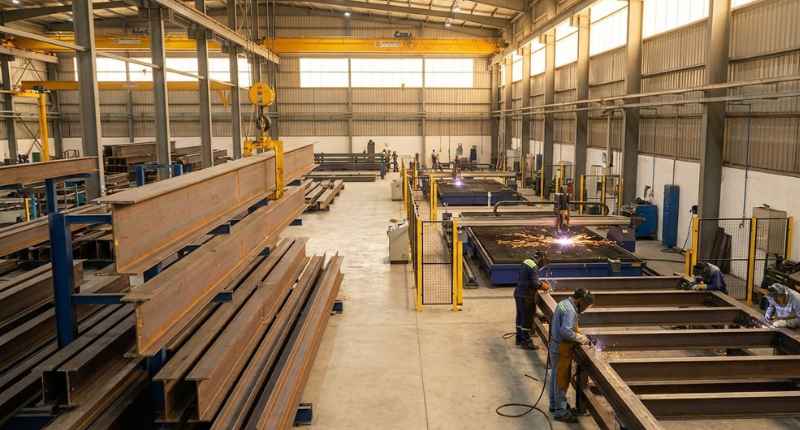
Custom metal fabrication starts from raw material and produces a component or assembly to a specific design. The geometry, dimensions, material grade, and configuration are defined by the application, not by what is available in a catalogue.
Custom fabrication pricing UAE reflects the full scope of that process: engineering time, material procurement, cutting, forming, welding, machining, inspection, and documentation. Every step adds cost that a standard solution has already absorbed across a production run of thousands of units. That is why custom fabrication costs more per unit at the point of manufacture. The question is whether that higher unit cost produces a lower total cost over the life of the asset.
Standard fabrication produces real cost savings in three scenarios.
The application fits the standard geometry without modification. A structural support frame built from standard RHS and angle sections, a pipework system using catalogued fittings and flanges, or a general steelwork package for a building or mezzanine are all cases where standard solutions match the requirement without compromise. Forcing custom fabrication onto these applications adds cost for no functional benefit.
The volume is too low to justify custom tooling. For one-off items where the geometry is close to a standard option, the engineering and setup cost of a custom solution rarely recovers against the small cost difference between the standard option and a modified standard. In these cases, adapting the design to fit the standard solution is the smarter economic decision.
Lead time is the primary constraint. Standard fabrication from stock material ships faster than custom fabrication in almost every case. Where schedule is the overriding factor and the application can accept a standard solution, the time saving has a genuine commercial value that offsets any performance compromise.
Custom fabrication pricing UAE buyers often focus on the upfront cost and miss the downstream savings. These are the scenarios where custom fabrication produces a lower total cost despite the higher unit price.
The application has no standard equivalent. Replacement parts for older or discontinued equipment, specialist components for oil and gas processing systems, and structural elements for non-standard configurations have no off-the-shelf solution. The choice is not between custom and standard. It is between custom fabrication and extended downtime or full equipment replacement. In that context, custom fabrication is the only option with a realistic cost attached to it.
Modifications to standard parts cost more than custom. This is the most commonly overlooked cost comparison in UAE procurement. A standard component that requires welded-on attachments, machined features, or dimensional modifications after purchase has absorbed the standard unit cost plus the modification cost plus the rework risk. A custom part produced to the correct specification from the outset frequently costs less than a standard part plus its modifications, and performs better because it was designed for the application rather than adapted to it.
Long service life recovers the upfront cost. Custom fabricated components designed for a specific load case, material environment, and maintenance access profile last longer than standard components that approximate the requirement. In applications like offshore structures, chemical processing equipment, and heavy equipment components, a custom part that lasts twice as long as a standard alternative at 1.4 times the upfront cost is the cheaper option over the asset life.
Comparing custom vs standard metal fabrication cost correctly requires looking at five cost categories, not just the fabrication invoice.
Unit fabrication cost is where standard fabrication wins in most cases. This is the number that appears on the quote and dominates most procurement decisions. It is also the least informative number for total cost analysis.
Modification and adaptation cost is where standard fabrication frequently loses its upfront advantage. Any standard component that requires modification to fit the application absorbs additional labour, welding, and machining costs that narrow or eliminate the price gap with custom.
Installation cost is affected by fit. A custom component designed to fit the installation geometry installs faster and with fewer field adjustments than a standard component adapted to a space it was not designed for. On offshore and industrial plant installations where labour rates are high, and working conditions are difficult, installation time differences have a significant cost impact.
Maintenance and replacement cost over the asset life is where long-run cost comparisons are decided. A custom component with a longer service life, designed for easier maintenance access and matched to the actual load and environment, produces lower lifecycle cost even at a higher initial price.
Downtime cost during replacement is the cost category most UAE buyers never put in the spreadsheet. When a standard component fails prematurely because it was the closest available option rather than the right option, the replacement cost is the fabrication price plus the downtime cost of the facility while the replacement is sourced and fitted. In production environments running at AED 50,000 to AED 200,000 per day of lost output, even a single additional replacement cycle makes a significant difference to the total cost calculation.
These costs are influenced by several underlying factors, including material selection, design complexity, manufacturing processes, labour requirements, quantity, finishing and delivery, all of which can significantly affect the final fabrication quotation.
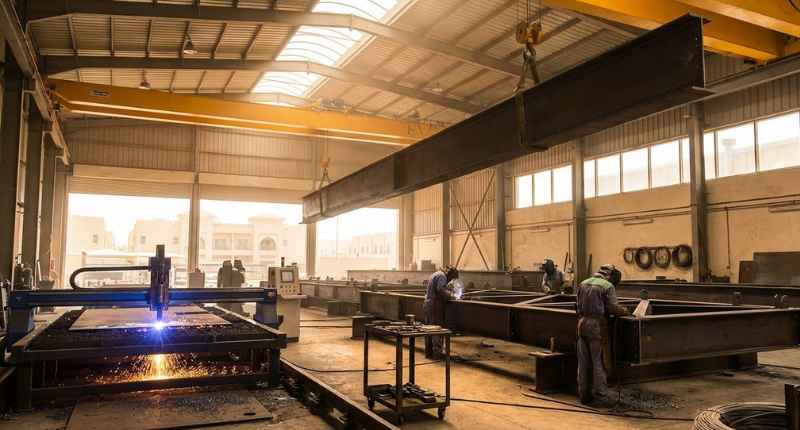
For buyers evaluating custom fabrication quotes in the UAE, understanding what drives the price makes it easier to evaluate quotes accurately and identify where cost can be reduced without compromising the outcome.
For a detailed breakdown of steel fabrication cost per kg in Dubai, including material, labour, machining, finishing, inspection and quantity-related costs, see our guide to current steel fabrication rates.
Material grade is the largest single cost variable in most custom fabrication jobs. Moving from mild steel to stainless steel multiplies material cost by four to six times. Moving to duplex stainless for oil and gas applications adds further cost. Specifying the right material grade for the actual service environment, not a conservative overspecification, is the highest-impact cost control decision available before fabrication begins.
Complexity of geometry determines machining and welding time. Simple profiles with straight cuts and standard joint configurations cost less to produce than complex assemblies with multiple weld preparations, tight dimensional tolerances, and non-standard features. Where the application allows simplification of geometry without functional compromise, that simplification reduces cost directly.
Documentation and inspection requirements add cost that is non-negotiable on safety-critical and compliance-driven applications. On general fabrication where these requirements are not mandated, removing them from the scope reduces cost without reducing structural performance.
Custom vs standard metal fabrication cost is not a comparison with a universal answer. Standard fabrication is cheaper upfront, and the right choice when the application fits, the volume is low, and the schedule is tight. Custom fabrication costs more to produce and less to own when the application has no standard equivalent, when modifications to standard parts cost more than building correctly from the start, and when service life and downtime avoidance are factored into the total cost.
UAE buyers who make this decision correctly are the ones who run the full lifecycle cost comparison, not just the fabrication invoice comparison, before committing to either option.
Contact Brightsun Industries to discuss your fabrication requirement and get an accurate assessment of which approach produces the better outcome for your specific application.
Q1: When does custom vs standard metal fabrication cost favour the custom option?
Custom fabrication produces lower total cost when the application has no standard equivalent, when standard parts require modifications that close the price gap, or when longer service life and reduced downtime offset the higher upfront fabrication price.
Q2: What drives custom fabrication pricing UAE buyers see on quotes?
Material grade, geometry complexity, weld preparation requirements, tolerance specifications, and documentation scope are the main cost drivers, with material grade selection typically having the largest single impact on the total fabrication price.
Q3: Can modifying a standard part cost more than custom fabrication?
Yes, a standard component that requires welded attachments, machined features, or dimensional changes after purchase frequently costs more than a custom part built to the correct specification from the start, and performs less reliably in service.
Q4: How does lead time factor into the custom vs standard fabrication decision?
Standard fabrication from stock ships faster in most cases, making it the right choice when schedule is the overriding constraint and the application can accept a standard solution without significant performance compromise.
Q5: What cost categories should UAE buyers include in a fabrication cost comparison?
Unit fabrication cost, modification and adaptation cost, installation cost, maintenance and replacement cost over the asset life, and downtime cost during replacement are the five categories that produce an accurate total cost comparison.
Q6: Why do standard components sometimes cost more over the asset life despite a lower upfront price?
Standard components that approximate rather than match the application requirement wear faster, require more frequent replacement, and produce downtime costs during each replacement cycle that accumulate to a higher total cost than a correctly specified custom component.
Q7: How does material grade affect custom fabrication pricing in the UAE?
Switching from mild steel to stainless steel multiplies material cost by four to six times, making material grade selection the highest-impact cost control decision available before fabrication begins on any custom job.
Q8: When is standard metal fabrication clearly the right choice in the UAE?
Standard fabrication is clearly right when the application geometry fits a catalogued solution without modification, the volume is too low to justify custom engineering and setup costs, or lead time is the primary constraint and a standard option is available from stock.
Q9: How should procurement teams in the UAE structure a cost comparison between custom and standard fabrication?
Run the comparison across the full asset life, including modification costs, installation time differences, expected service life, replacement frequency, and downtime cost per replacement cycle, rather than comparing fabrication invoices alone.
Q10: Does custom fabrication always take longer than standard fabrication in the UAE?
Not always, because standard components that require significant modification after purchase can take as long to prepare for installation as a custom part built to specification, particularly when modifications require welding, machining, or third-party processing.
At a Glance
Related Blogs

Shed No. 10, Fresh Express Warehouse,
Road B1, Dubai Investments Park 1,
Dubai, UAE.
+971 43807099
+971 563244963
+971 503226480