- +971 43807099
- +971 563244963
- brisunco@emirates.net.ae

- Meet Us
Shed No. 10,
Fresh Express Warehouse, Road B1, DIP 1,
Dubai, UAE.
Shed No. 10,
Fresh Express Warehouse, Road B1, DIP 1,
Dubai, UAE.
New
New
Most clients who commission custom steel fabrication have a clear picture of what they want at the start and a finished installation at the end. What happens in between is often a black box. That gap is where project delays, scope disputes, and quality problems originate.
Understanding the custom steel fabrication process from design through to installation gives procurement managers and project engineers a clearer basis for planning timelines, writing specifications, and managing fabrication contracts in the UAE.
For an overview focused specifically on machinery components, replacement parts, and industrial equipment, see custom steel fabrication for industrial equipment.
At a Glance
The custom steel fabrication process starts before any steel is cut. It starts with a design that is complete enough to fabricate from.
For structural work, this means detailed drawings with full dimensions, material specifications, weld symbols, surface treatment requirements, and tolerance callouts on critical features. Fabrication drawings are not concept drawings. They contain the information a fabricator needs to produce the component correctly without making assumptions. Assumptions in fabrication produce non-conformances.
For a broader overview of custom steel fabrication services in UAE, including fabrication methods, materials, quality checks, and costs, see Brightsun’s complete guide.
Before starting the fabrication process, it is important to understand whether the project requires structural steel or custom steel fabrication in the UAE.
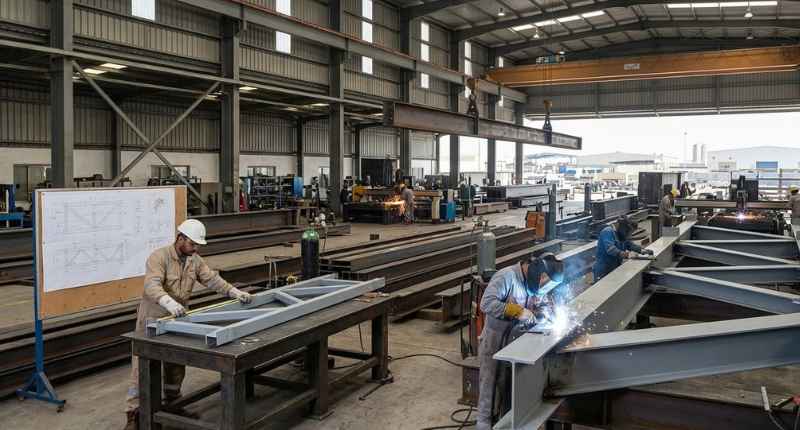
Once the design is approved, material procurement begins. Common mild steel sections and plate are typically available from UAE stockholders within one to three days. Specialty grades including stainless steel, duplex stainless, and pressure vessel quality plate carry procurement lead times of one to three weeks and must be factored into the project schedule from the outset.
Traceability starts at procurement. Every piece of material should be received against a mill certificate recording the heat number, chemical composition, and mechanical properties. The heat number is marked on the material and tracked through cutting, fit-up, welding, and final inspection. For oil and gas, marine, and pressure equipment fabrication in the UAE, this traceability chain is a code requirement. For general structural work, it protects both fabricator and client if material quality is ever questioned.
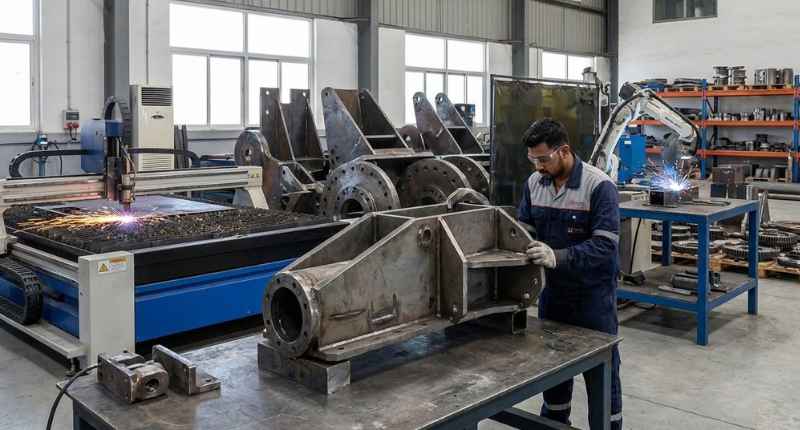
With material procured and certified, cutting begins. The cutting method depends on material, thickness, and the edge quality the application requires.
Waterjet cutting is specified where no heat-affected zone is required or where dimensional accuracy exceeds what plasma cutting delivers. Plasma cutting suits carbon steel plate where speed matters and the heat-affected zone is acceptable. Laser cutting handles thin to medium sheet with tight tolerances. Oxy-fuel cutting covers heavy structural sections and thick plate.
Cutting is where dimensional accuracy is established for the first time. Errors here propagate through fit-up and welding and become progressively more expensive to correct. Profile checking after cutting, before parts move to fit-up, is a quality step that fabrication shops build into their sequence as standard.
Many custom steel fabrication components require forming before fit-up and welding. Plate rolling produces cylindrical shells for pressure vessels and tanks. Press braking forms angles and box sections from flat plate. Section bending curves structural sections for architectural and structural applications.
Forming introduces residual stress into the material. For pressure vessel shells, out-of-roundness after rolling is checked against the ASME code tolerance before the shell moves to fit-up. Catching this before welding is the difference between a straightforward correction and an expensive repair.
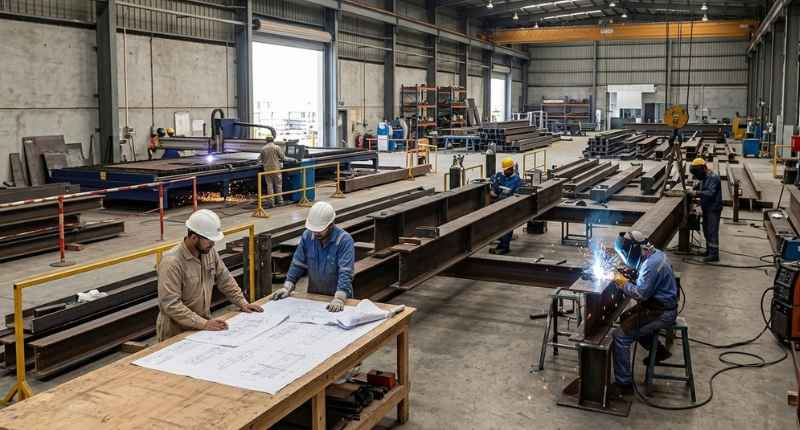
Fit-up is where cut and formed components are assembled into the configuration they will be welded in. It is also where dimensional errors from earlier in the sequence either compound or get caught and corrected.
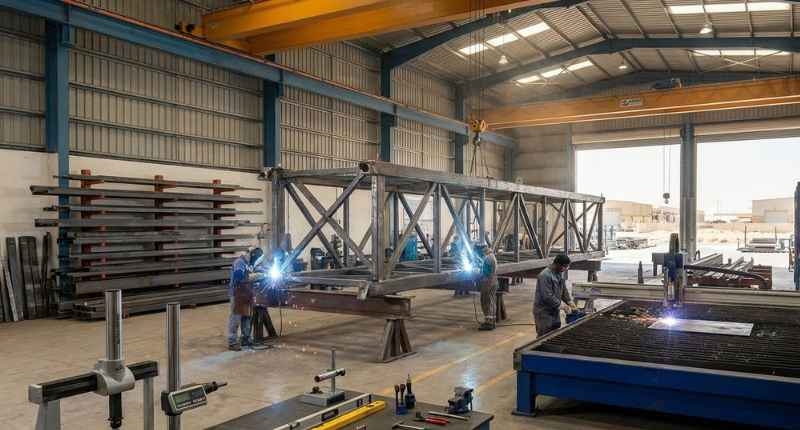
Good fit-up practice includes checking joint gaps against the welding procedure specification, verifying alignment before tacking, and confirming that the assembled geometry matches the drawing before any permanent welding begins. For large structural assemblies, fit-up is carried out on a level surface plate that provides a known datum for dimensional checking. Assemblies fit up on an uneven floor produce errors that only become apparent during installation, when they are expensive to correct.
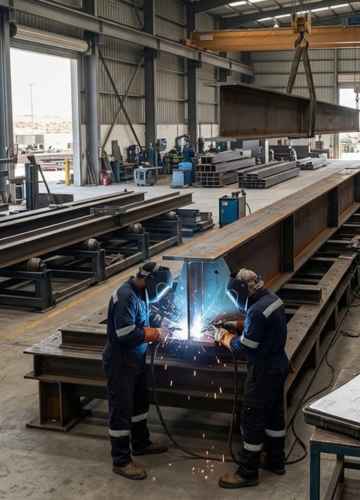
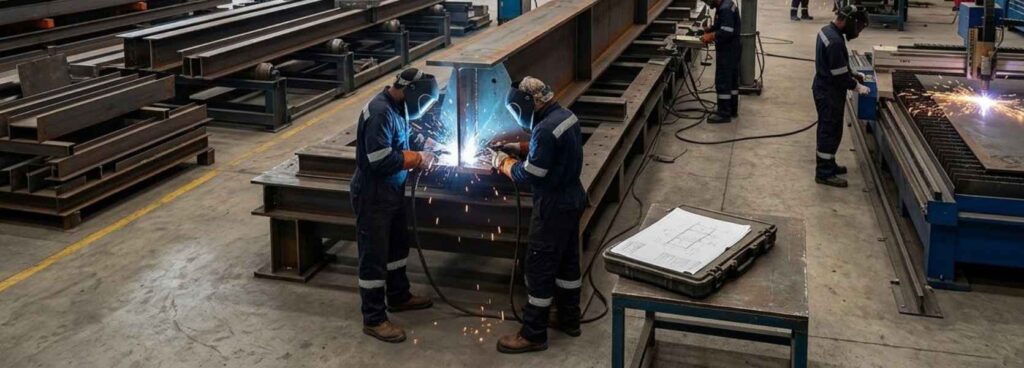
Every production weld on a coded or quality-controlled job must be made to a qualified Welding Procedure Specification. The WPS defines the welding process, filler material, preheat temperature, interpass temperature, and heat input range. The welder must hold a current qualification for the joint type, position, and material group. These documents must be available at the workstation.
Welding distortion is managed through sequence, not corrected after the fact. A sequence that balances heat input around the neutral axis minimises distortion as welding progresses. Experienced fabrication shops design the welding sequence before the first arc is struck.
Post-weld heat treatment is required on certain material grades and thicknesses to relieve residual stress and restore material properties in the heat-affected zone. It is carried out to a defined time and temperature cycle, monitored by thermocouples, and recorded on a chart that becomes part of the quality record.
Non-destructive testing examines weld quality without damaging the component. Radiographic testing, ultrasonic testing, magnetic particle inspection, and dye penetrant inspection are all used depending on the weld type, the applicable code, and joint criticality. NDT results are documented and reviewed against the acceptance criteria of the applicable standard before the component moves forward.
Surface treatment protects fabricated steel in service. The correct system depends on the service environment, design life, and maintenance access during operation.
Abrasive blasting to Sa 2.5 is the standard surface preparation for most industrial and marine coating systems. Primer application follows blasting within the overcoat window specified by the coating manufacturer. Intermediate and topcoats are applied to the specified dry film thickness and verified by DFT gauge and holiday detector before release. A correctly fabricated component with a poorly applied coating will fail in service from the coating outward.
Before a fabricated component leaves the workshop, final inspection checks all critical dimensions, verifies surface treatment quality, confirms NDT completion, and assembles the complete quality documentation package.
A properly managed data package includes material test reports, a weld map with procedure and welder identification for every weld, NDT reports, dimensional inspection records, post-weld heat treatment charts where applicable, and coating inspection records. This package travels with the component and becomes part of the asset maintenance record for the life of the installation.
Transport of large or heavy fabricated components requires logistics planning that starts during fabrication. Oversized loads need permits and route planning. Components with finished coating need protection during transport. Installation supervision by the fabrication team on complex components provides continuity between workshop and site that an installation team encountering the component for the first time cannot replicate.
This is why how to select a custom steel fabricator in Dubai should include checking the supplier’s ability to manage quality documentation, inspection, delivery, and installation support as part of the complete fabrication scope.
The custom steel fabrication process is a sequence of interdependent stages where the quality of each stage determines the starting conditions for the next. Design completeness determines procurement accuracy. Cutting accuracy determines fit-up quality. Fit-up quality determines weld quality. Each stage builds on the one before it, and errors compound forward rather than staying contained.
UAE clients who understand this sequence are better positioned to write complete specifications, plan realistic timelines, and manage fabrication contracts in a way that produces the right outcome at installation.
Brightsun Industries manages the complete custom steel fabrication process from design review through to delivery and installation support across Dubai and the UAE, with ISO 9001:2015 certified quality systems, qualified welders, and documented inspection at every stage.
Contact us here to discuss your fabrication requirement and project timeline.
Q1: What are the main stages of the custom steel fabrication process?
The stages run from design and engineering through material procurement, cutting, forming, fit-up, welding, post-weld treatment, surface treatment, final inspection and documentation, to delivery and installation.
Q2: How does steel fabrication design-to-delivery UAE projects manage material traceability?
Mill certificate heat numbers are marked on each piece of material at receipt and tracked through every subsequent stage so that the material properties of any component can be verified at any point in the fabrication sequence.
Q3: Why does fit-up quality directly affect weld quality in the fabrication process?
Incorrect joint gaps and misalignment at fit-up produce weld defects including lack of fusion and incomplete penetration that are significantly more expensive to correct after welding than to prevent through correct fit-up practice.
Q4: What documents should be in a complete steel fabrication data package?
A complete package includes material test reports, a weld map with procedure and welder identification, NDT reports, dimensional inspection records, post-weld heat treatment charts where applicable, and coating inspection records.
Q5: How long does the custom steel fabrication process take from design to delivery in the UAE?
Standard structural fabrication typically runs two to six weeks from approved drawings, while coded pressure equipment fabrication runs six to sixteen weeks depending on size, material, and inspection scope.
Q6: When is post-weld heat treatment required in the custom steel fabrication process?
Post-weld heat treatment is required under ASME and other codes for specific material grades and wall thicknesses to relieve residual stress and restore heat-affected zone properties, with the requirement determined by material group, thickness, and applicable code.
Q7: What surface preparation standard applies before coating fabricated steel in UAE projects?
SA 2.5 abrasive blast cleaning is the standard for most industrial and marine coating systems, providing the clean angular surface that allows the primer to bond and perform to its specified corrosion protection life.
Q8: Why is cutting accuracy so important early in the steel fabrication sequence?
Dimensional errors introduced at the cutting stage propagate through fit-up and welding and become progressively more expensive to correct with each subsequent stage, making profile checking immediately after cutting a critical quality control step.
Q9: What is a welding procedure specification and why is it required in the fabrication process?
A welding procedure specification defines all the parameters that must be followed during production welding to ensure every weld is made under the same controlled conditions that produced the qualified test weld, covering process, filler material, preheat, interpass temperature, and heat input range.
Q10: How should large custom fabricated steel components be prepared for transport in the UAE?
Transport planning including permit applications, route surveys, and lifting attachment fabrication should begin during the fabrication stage, with coating protection measures confirmed and loading arrangements engineered before the component leaves the workshop.
At a Glance
Related Blogs

Shed No. 10, Fresh Express Warehouse,
Road B1, Dubai Investments Park 1,
Dubai, UAE.
+971 43807099
+971 563244963
+971 503226480